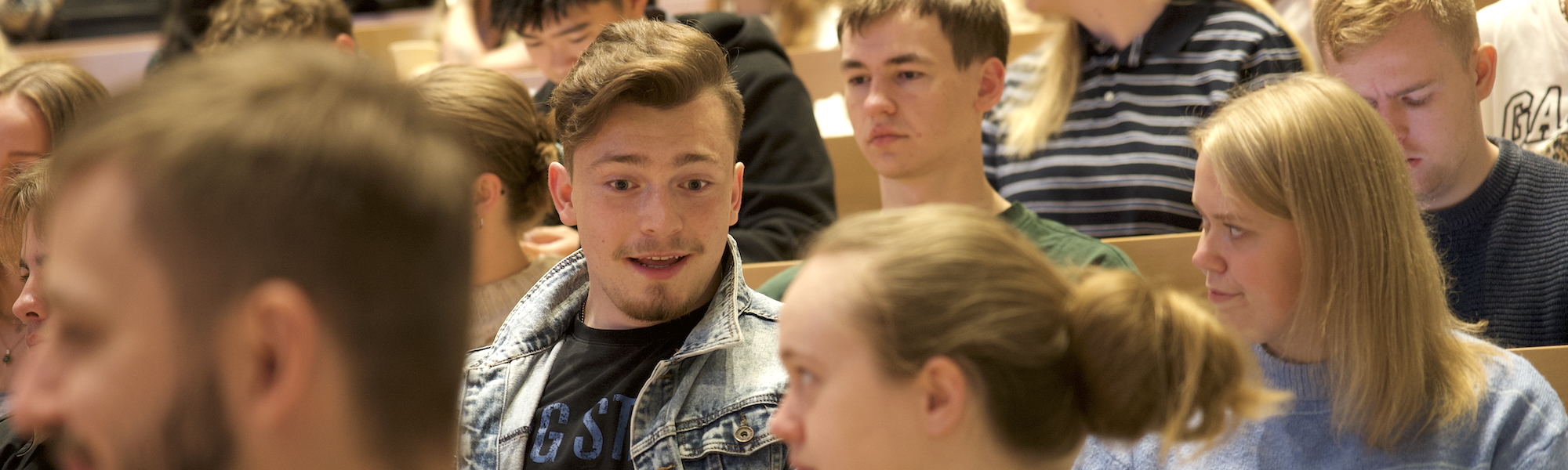
Welcome to 1,188 new students
The Faculty of Science is expanding its record-high intake from 2024 and is making overall progress on both bachelor's and master's degree programmes in 2025
With the study start this week, we have embarked on a new semester. And never before have we at the faculty welcomed so many people to our programmes.
547 have accepted a place on one of the 11 bachelor's degree programmes that fall under the administration of the Faculty of Science. In addition, there are 31 on the Mathematics-Economics programme, which belongs to the Faculty of Business and Social Sciences, but is run jointly.
On the master's degree programmes, 610 have also accepted the offer to enrol on a degree programme at the Faculty og Science This is more than twice as many as the 288 who started on one of our master's degree programmes five years ago in 2020.
The bachelor's admissions
Keeping up with the admissions process can be a bit of a rollercoaster ride. Especially on bachelor's degree programmes.
First, you keep an eye on the applicant numbers when quota 2 applications open at the beginning of the year. Day by day, the applications keep coming in until 15 March, when the application deadline and quota 2 close.
Our faculty received a total of 1,353 applications this year compared to 1,035 applications last year. A nice increase – at least on the surface.
This year, the admission requirements in quota 1 increased, so you need a 7.0 grade point average to get into almost all programmes instead of just a 6.0 average, which was the most common grade requirement last year. As a result, more applicants were forced to apply through quota 2 this year.
Furthermore, the number of applications can be a misleading indicator, as the same applicant can send up to eight applications in order of priority.
Therefore, the number of first-priority applications is more interesting to follow because each applicant can only have one first priority across all programmes and institutions. And in quota 2, we received 304 this year, which is 18 % more than the 257 last year.
After the quota 2 deadline, it takes some time before you can follow the daily updates from SDU Analytics with the latest figures in quota 1. The 18 % lead slowly decreased to around 9 % in June when comparing the daily development with the same day the year before.
Just before the quota 1 application deadline on 5 July, the lead dropped more drastically. A total of 507 potential students had submitted first-priority applications for one of the faculty's programmes this year, compared to 496 last year, when the faculty broke its own record, increasing its lead by just over 2 % – quite good for our faculty, you might say!
Unfortunately, the rollercoaster ride does not end here. All applications are handled during the summer and on 28 July the number of spots offered was announced. The three-week wait in July feels like an eternity for both applicants and the faculty.
599 applicants from quota 1 and 2, across lower priorities as well as first priority, were offered a place. Last year – which was a record year – the Faculty of Science offered a spot to 589. A growth of just under 2 % more in 2025. Still pretty good.
Next up on the rollercoaster ride is the number of offers accepted. Even though applicants are offered a spot on the programme they have prioritised the highest and are qualified to enter, there are applicants who turn it down.
Fortunately, this year, very few did just that. 517 accepted our offer to join us. A good 3 % more than the 501 who accepted last year.
You might think that's it – and that was the new record for bachelor's admissions at the Faculty of Science Science, but after 28 July, round 2 opens with available spots. This year, the faculty received an additional 47 applications in round 2. Some of these were not qualified and a few ultimately turned down an offer to join, while 30 accepted.
Thus, 547 students have been enrolled on one of the bachelor's degree programmes in the natural sciences at SDU. Almost 4 % more than last year, when 527 in total were welcomed to the faculty's bachelor's degree programmes.
The new bachelor students are divided into 20 and 29 in Applied Mathematics and Mathematics, respectively, 30 in Artificial Intelligence, and 67 in Computer Science.
The Department of Physics, Chemistry and Pharmacy has received 118 students in Pharmacy, 20 in Medicinal Chemistry, 9 in Chemistry, and 21 in Physics.
Biochemistry and Molecular Biology and Biomedicine welcome 42 and 117 new students, respectively.
Last but not least, Biology has welcomed 74 new students to the bachelor's degree programme.
Master's programme admissions
The application deadline for the master's degree programmes was already 1 March, and here too, we have paid most attention to the first-priority applications.
However, there can be a big difference between the number of first-priority applications and the number of final admissions, because the master's intake – unlike the bachelor's intake – is not coordinated across higher educational institutions.
This means that we cannot know whether the first-priority application for one of SDU's master's degree programmes is actually the applicant's overall first priority – or whether it is the applicant's greatest wish to take a master's degree programme at another university.
In total, the faculty received 1,665 applications for master's degree programmes this year. Of these, 1,203 were first-priority applications. Both key figures are significantly higher than last year, when the faculty received a total of 1,235 applications, 895 of which were first-priority applications.
Whereas last year 787 were offered a place and 527 accepted, this year 922 places were offered to join us, of which 610 accepted. More than half of the latter, 341, have been enrolled on one of the two master's degree programmes in Data Science – 107 of them at SDU Kolding and 234 at SDU Odense.
Data Science at SDU Odense had its first intake in 2019, and in 2024 its counterpart at SDU Kolding was added. The doubling in the number of admissions to the master's degree programmes since 2020 can, therefore, mainly be explained by the popularity of Data Science.
In addition, a new master's degree programme called Quantum Computing was created this year. Here, 43 qualified applicants were offered a spot. Of those, 18 accepted and were enrolled on the programme.
While anyone with a bachelor's degree or an equivalent level of education can be admitted to Data Science, Quantum Computing is a more specialised programme that requires a background in Physics, Mathematics or Computer Science at bachelor's level.
Smaller cohorts, more programmes
It's hard to predict what enrolment at the Faculty of Science will look like in the future. On the one hand, we expect to see an effect of declining youth cohorts, on the other hand, the faculty has more programmes on the way.
Next year, we will open up admission to the master's degree programme in Artificial Intelligence at SDU Odense. At the same time, we will have two new international bachelor's degree programmes at SDU Vejle – Computer Science and Artificial Intelligence – and similar master's degree programmes will follow as early as 2028.
We can also expect the application patterns for our master's degree programmes to change when the master's degree reform is implemented. In 2028, some master's programmes will consist of 75 ECTS credits, others of 120, and some will be offered as part-time master's programmes for working professionals.
It is possible to find many more figures on applications, places offered and final intake in the SDU Analysis Portal.
