Climate
Local targets to help reduce emissions from travel
Reducing greenhouse gas emissions from work-related trips is an important part of SDU’s overall climate work. The overall reduction target towards 2030 has now been distributed across the University’s main areas, so that local targets can motivate managers and employees to change their travel behaviour.
With Climate Plan 2.0 (for the period 2025–2027), SDU’s Board decided that greenhouse gas emissions from work-related trips must be reduced by 57 per cent by 2030.
SDU remains within the trend line towards 2030. However, after a period of significant decline in travel activities, the emissions from work-related trips increased by 24 per cent from 2023 to 2024. The figures for 2025 are not ready yet.
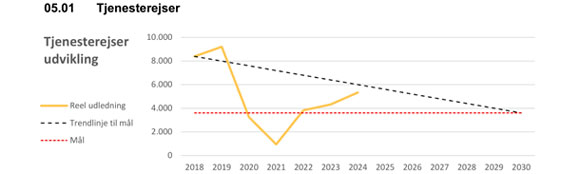
SDU’s emissions (reel udledning) are below the linear trend line (trendlinje) towards the 2030 target (mål), but emissions from work-related trips have been increasing since 2021 (‘SDU Climate Accounting 2018–2024’, page 7).
In the effort to reduce emissions – which are not least due to air travel – towards 2030, SDU’s Executive Board has decided that the individual main areas – the faculties and the Central Administration – will be given independent reduction targets.
Targets will be regulated by employee development and travel intensity
This will be achieved by means of a new distribution model for work-related trips. A 57 per cent reduction by 2030 is still SDU’s overall target, but the responsibility for reducing the emissions is allocated to each main area based on developments in the number of employees and in travel activity. Each main area will translate its target figures into local priorities and initiatives.
- A clear local anchoring is needed. Travel activity varies widely among the main areas, so it makes sense for each area to have a target that reflects its activities and framework conditions. If we are to reach the 2030 target, the main areas must translate the target figures into specific priorities locally, says University Director Thomas Buchvald Vind.
New travel circular and new expectations regarding behaviour
In December, the Executive Board approved SDU’s internal circular on work-related trips, which constitutes the framework for these efforts. The circular states, among other things, that sustainable modes of transportation should be the natural choice and that, as a rule, air travel should be used only when there are no realistic alternatives.
The circular sets the framework but does not change travel behaviour per se. To do so requires insight into local travel patterns and systematic follow-up.
The new target figures will become part of the overall management dialogue, including at biannual meetings between the Rector, the deans and the University Director. A prerequisite for success is that the main areas get better access to data on travel activity and emissions, so that their units will have a better basis for climate-friendly actions.
Support for local anchoring
In the coming months, the Central Administration will offer assistance to the main areas in their work with travel data and the reduction of emissions. The aim is that this work will become part of the University’s daily operations.
The data show that about 80 per cent of the emissions from work-related trips stem from about 20 per cent of the trips. It may therefore be relevant to look more closely at local travel patterns and transport choices in those groups.
The support is not about control but about providing better tools for more informed reduction measures.
- We are a university and work-related trips are an inherent part of research, collaboration and professional development. The purpose is not to restrict necessary travel. However, the new decisions imply an expectation that air travel will be assessed in terms of whether it they are necessary and whether there is a climate-friendly alternative. The effort to reduce emissions should be an integral part of the local management task, and purpose, frequency and alternatives must be clear parameters in decisions regarding travel, emphasises Thomas Buchvald Vind.
Read more at Climate at SDU.