After million-dollar sale: SDU innovators go worldwide with sensor tech
This summer, Maturix was acquired by the French construction giant Saint-Gobain. Read on and get CCO Casper Harlev’s story about the journey from SDU to international success – and three useful tips for others with entrepreneurial aspirations
Few people – probably not even themselves – had expected two SDU students’ joint interest in sensors and Bluetooth solutions to end up as a million-dollar business.
But that is how things turned out for SDU entrepreneurs Casper Harlev and Tobias Ejersbo from Maturix, who sold their company to the billion-dollar group Saint-Gobain this summer.
Maturix’s story started in the entrepreneurial environment at SDU, where the two engineering students’ interest in digital technologies and their desire to start their own business had ample opportunity to unfold.
- The first milestone for us was definitely our time at SDU. We learned a lot about turning good ideas into strong concepts, and the lecturers allowed students to work with their own concepts across the courses.
- It was also immensely important that we met other student startups in Cortex Park. It gave us the opportunity to talk openly about the challenges we were facing along the way. At the same time, of course, we competed fiercely against each other in the Venture Cup and other entrepreneurial competitions, says Casper Harlev with a smile as we meet him at Maturix’s headquarters in the centre of Odense.
Odense and young meets French and historical
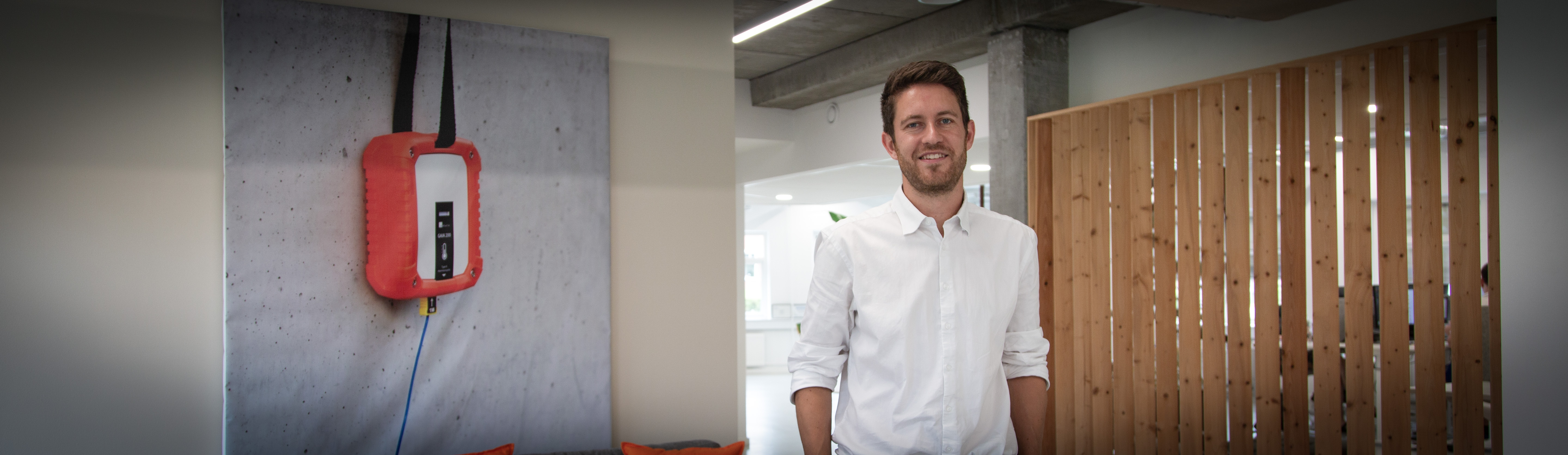
A very happy and proud Casper Harlev gives us a tour of the entrepreneurial company, which today has 14 full-time employees.
- It is a huge confirmation that the products, the company, the team and the vision – everything we began building at SDU – have just been bought by a huge corporation.
The next stop for Casper Harlev and Maturix is Brazil. In Brazil, he will collaborate with Saint-Gobain to boost the sales of sensors that provide wireless real-time measurements of concrete, opening up a completely new market.
The opportunities to enter the global market are the reason why Maturix is now joining forces with the French construction giant, which was founded in the 17th century and has helped build parts of the Palace of Versailles.
- In recent years, we have proven that we are able to scale our business and we are performing very well in the European market. Three years ago, Saint-Gobain reached out to us because they wanted to collaborate commercially on our sensors, says Casper Harlev and elaborates:
- We realised relatively quickly that a sale would give us much better opportunities to take the next steps into the markets of South and North America, the Middle East and China. For a company of our size, such a venture would be a huge task, but with the sale to Saint-Gobain we can really speed up the process.
At the same time, he emphasises that much remains the same as before in Maturix – even after the sale. The management and the team will continue as before from the address on Ejlskovsgade in Odense. Now they will just have to send monthly reports to Paris – and hopefully sell sensors all over the world.
From experience-based to data-driven
The entrepreneurial spirit lives on at Maturix – because there is still plenty of work to be done to achieve the goal of helping the construction industry move from experience-based to data-driven concrete casting.
In particular, the new and greener types of concrete, which are currently driving the development in the construction industry, provide great opportunities for continued growth in Maturix, Casper Harlev explains.
- For the new types of concrete, no one in the industry has any experience with curing times, etc., so our sensors can really help customers improve their decision-making, manage risk and prevent problems with cracks in the concrete.
Three useful tips
Let us end with Maturix-founder Casper Harlev’s three top tips for others who have entrepreneurial aspirations – based on his experience of building Maturix from idea to a million-dollar sale.
- Boost your luck with cold canvas
- For us, it all started when we contacted HeidelbergCement and they decided to give us and our sensors a chance. They had tried to make their production more data-driven but they had not reached their goal, so they were open to new ideas and solutions.
- Keep going – even when things look bleak
- After we had hired our first developer, we were millimetres away from going bankrupt. We owed DKK 1 million and had no more money to pay wages. Not even our parents wanted to invest money in our company back then. At the last minute, we managed to get an emergency investor from the entrepreneurial environment in Odense so that we could continue. That was probably the moment when we really committed to going all the way with Maturix – no matter what happened.
- Network with customers
- We have had a strong focus on building good cases in close collaboration with our customers. In this way, we and our customers have been able to tell and document what our customers have achieved in terms of optimisation and cost cutting by using our sensors.
Our customer network has also been able to help us get new customers. We have always focused on asking our customers if they knew anyone who would also benefit our solutions.
Facts – Maturix in brief
The company was founded in 2014 as Sensohive. At that time, it consisted of three SDU students: Casper Harlev, Tobias Ejersbo and Tim Larsen.
In 2016, the company launched its first sensor series, Orbit 3 and Orbit K, to measure humidity and temperatures in the horticultural and food industries.
In 2017, Sensohive launched Maturix – a sensor system for the construction industry that can provide real-time measurements of concrete as it cures.
At the beginning of 2022, the company Sensohive and the product name Maturix merged and the company continued under the name of Maturix. Shortly after, Tim Larsen decided to leave the company.
In recent years, the Maturix sensors have been part of many large construction projects in Scandinavia and throughout Europe, such as the Karla Tower in Gothenburg (Scandinavia’s tallest building) and the Cactus Towers in Copenhagen.
In 2025, Maturix was sold to the French construction company Saint-Gobain.