International business accreditation: We’re allowed to dream big – and we do!
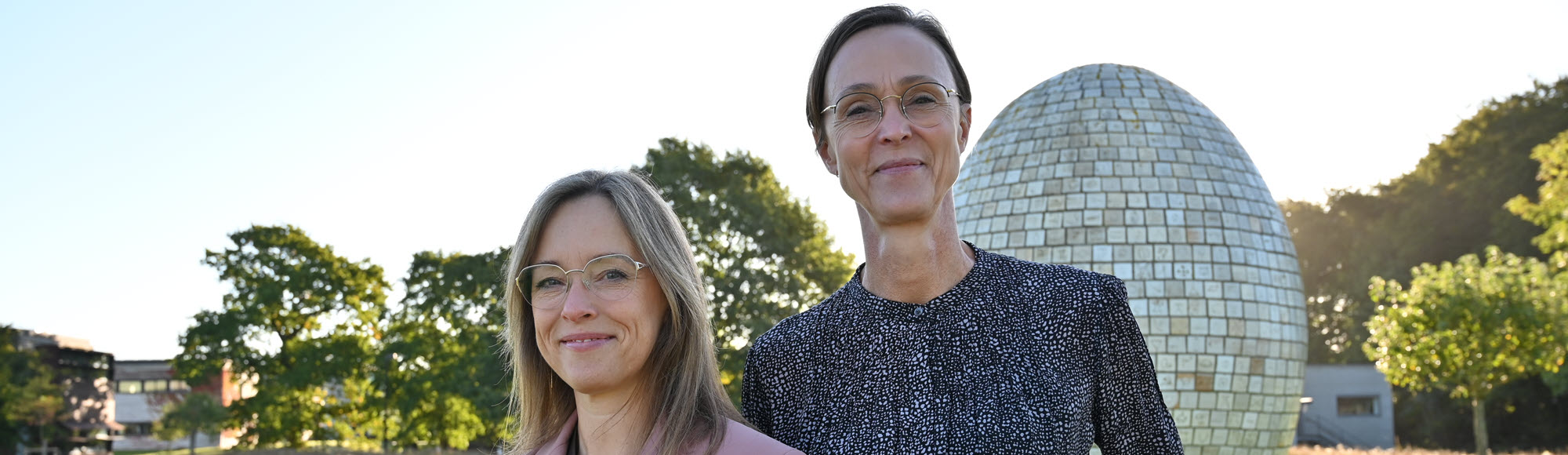
During the summer, the Faculty of Business and Social Sciences received some great news: The University of Southern Denmark and the Faculty have earned a coveted international accreditation, placing the University’s Business School among the top 6 per cent of institutions worldwide that hold it. We spoke to Hanne Søndergaard Birkmose and Kristin B. Munksgaard about its value.
We’re allowed to dream big! This was the encouraging feedback when SDU received the prestigious global accreditation from the AACSB (Association to Advance Collegiate Schools of Business) this summer. As with international rankings, it is a seal of quality that the University can be proud of. This means that in addition to meeting AACSB’s high requirements and quality standards, SDU gains access to an exclusive network of business schools worldwide.
Access to a special league
- This gives us access to a special league where we can tap into the knowledge and experience of some of the world’s leading business schools. It also gives us a better opportunity to attract some of the most talented students and excellent researchers, explains Hanne Søndergaard Birkmose, Dean of the Faculty of Business and Social Sciences.
She adds:
- Ultimately, the accreditation efforts are about ensuring top-class research and programmes that generate real value for students, employers and society – both regionally and internationally.
Another benefit of the accreditation is the opportunity to share experiences with the rest of the University. In fact, the lessons learnt from the accreditation efforts have already been utilised in the development of SDU’s new quality policy for teaching.
- We now have new tools and methods in our toolbox to support teaching quality and development. These tools are also valuable for faculties and programmes beyond the Faculty of Business and Social Sciences and the Business School, says Vice Dean Kristin B. Munksgaard, who heads the University of Southern Denmark Business School.
Continuous improvement as a cornerstone
The cornerstone of achieving and maintaining accreditation is, in Kristin B. Munksgaard’s words: ‘continuous improvement’ – a commitment to systematically and consistently improving and developing the Faculty’s processes and workflows across teaching, research and administration.
And as Hanne Søndergaard Birkmose puts it:
- At the same time, we aim to ensure that individual employees do not perceive the work with continuous improvement as yet another layer of tasks imposed on them, but rather as something naturally integrated into what we already do and the processes we already have – for example, in relation to educational quality.
A common language
The accreditation is the culmination of many years of work that the entire faculty and other parts of the University have put a lot of effort into. In addition to accreditation providing a new ‘common language’ for the quality in the programmes, the process itself has also offered a great deal of learning.
- One of the areas we have placed extra focus on in our efforts to achieve accreditation is who we involve in our teaching. For example, it’s important that we focus on ensuring that we bring the right skill sets and relevant experience into the teaching, especially when it comes to external lecturers. We’ve also had many engaging discussions about which initiatives we want to continue working on and about our strengths in research and impact, says Kristin B. Munksgaard.
Hanne Søndergaard Birkmose and Kristin B. Munksgaard both emphasise that it is worth remembering that the process leading up to accreditation reflects something about the colleagues they encounter in their daily work:
- The close collaboration between researchers, lecturers and administrative colleagues is key to the success of both day-to-day tasks and new projects. Yet, precisely because it works so well, it sometimes goes unnoticed in everyday life.
Other international networks in focus
Going back to the beginning and the call from AACSB to dream big, the question is, what’s next?
- First and foremost, we are pleased that several years of dedicated work have given us the accreditation we have been striving for, but it is also natural that we start looking forward to one or more of the other international business school accreditations. As we make good progress in anchoring the work with this accreditation, we will begin the concrete tasks. As preparation, we are already involved in the relevant international networks that will form the basis for the next steps, concludes Hanne Søndergaard Birkmose.
Facts – About the Association to Advance Collegiate Schools of Business (AACSB)
AACSB focuses on elevating the quality and impact of business schools globally. To earn AACSB accreditation, an institution must undergo a rigorous and comprehensive evaluation process conducted by international peers.
Founded in 1916, AACSB is the world’s largest business education association. Representing 2,000 institutional members and over 1,000 accredited members across 100 countries, the organisation connects business schools, companies and students to create the next generation of great leaders.