The Humanities Model shows how SDU’s core principles are implemented in the planning of teaching and study activities. The model supports engaging teaching and committed learning communities by distributing learning activities and responsibilities between lecturers and students across four spaces. In this way, the model gives concrete expression to the programmes’ focus on student-centred learning.
The Humanities Model is based on the premise that teaching activities take place in different “spaces”, defined by the roles and responsibilities of lecturers and students. The model makes visible the fact that students assume different roles throughout their studies and contribute different types of outputs.
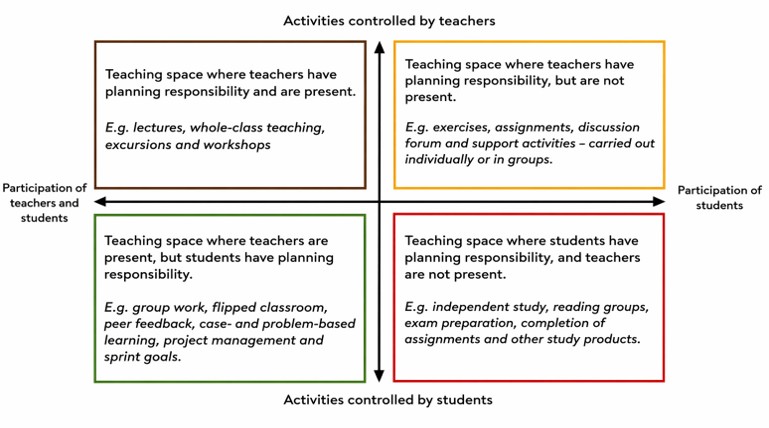
Students’ study activities are organised and structured within four spaces. Taken together, the division into spaces clarifies how responsibility, presence and planning are distributed in different ways between lecturers and students within a teaching course:
On the basis of the four spaces, the lecturer plans and delivers engaging teaching, including:
- incorporating all four spaces with due regard to the learning outcomes of the individual course
- making clear the responsibilities students have in relation to participation in the different spaces
- supporting students in developing the study skills required to work within the different spaces
The lecturer reflects on which activities may take place in the four spaces and how these activities relate to the course objectives and assessment.
The programme management ensures that, taken as a whole, students have activities in all four spaces in every semester and that lecturers’ competences are utilised as effectively as possible in the implementation of the model.
The model makes clear that students have different forms of responsibility and different tasks associated with the various study activities, and that different types of outputs and contributions are expected in the individual spaces. In this way, students become aware of and familiar with varied forms of academic work and tasks within their discipline.
Teaching space in which the lecturer has planning responsibility and is present
This space typically includes lectures and class teaching with engaging elements, excursions and workshops. Students participate actively, for example by asking questions, reflecting, taking notes and contributing to discussions and problem-solving in groups and in plenary sessions.
This space particularly supports the principle of student-centred learning and committed learning communities.
Engaging elements may, for example, include group-based problem-solving, buzz groups, reflective questions, quizzes and the preparation of concept maps.
Study space in which the lecturer has planning responsibility but is not present
This space may typically include group work, exercises, problem-solving and similar activities structured by the lecturer, in which the student participates actively.
This space particularly supports the principles of student-centred learning, engaging teaching and committed learning communities.
Examples may include work on study questions relating to the syllabus, logbooks, contributions to blogs or wikis, collecting material for one’s own or a group portfolio, working on tasks in groups between teaching sessions, as well as fieldwork.
Teaching space in which the lecturer is present, but students have planning responsibility for specific sub-activities
This space may typically include group presentations, supervision and question-and-answer sessions (and similar activities) within the framework of the course. Students participate actively, for example by giving presentations, responding to fellow students’ presentations (possibly with varying opponent roles), and taking the initiative to arrange and prepare supervision, either individually or in groups.
This space particularly supports the principle of student-centred learning and committed learning communities.
This space may, for example, include group presentations, flipped classroom activities, peer feedback, case- and problem-based learning, project supervision and question-and-answer sessions.
Study space in which students have planning responsibility and the lecturer is not present
This space includes the student’s independent study, active participation in self-organised reading groups and joint examination preparation, as well as the preparation of assignments and other study products.
This space particularly supports the principles of student-centred learning, engaging teaching and committed learning communities.
The four spaces may be combined in different ways depending on the course objectives, teaching format and assessment. The key point is that students encounter and are trained in several types of learning activities throughout the semester.
The Humanities Model is an overarching model that applies to all programmes within the Faculty of Humanities. The model describes existing practice, in which engaging pedagogical forms already play a major role, and at the same time serves as a point of reference for the continued development of teaching at the faculty. The Board of Studies for each individual programme determines in detail how the model is expressed in the programme concerned.