Art at the Faculty of Health Sciences
The art shaping the Faculty of Health Sciences
From chandelier to digital patterns and poisonous plants. All artworks at the Faculty of Health Sciences are now in place. Explore the five installations and meet the artists behind them.
The transition zone – Philippe Parreno
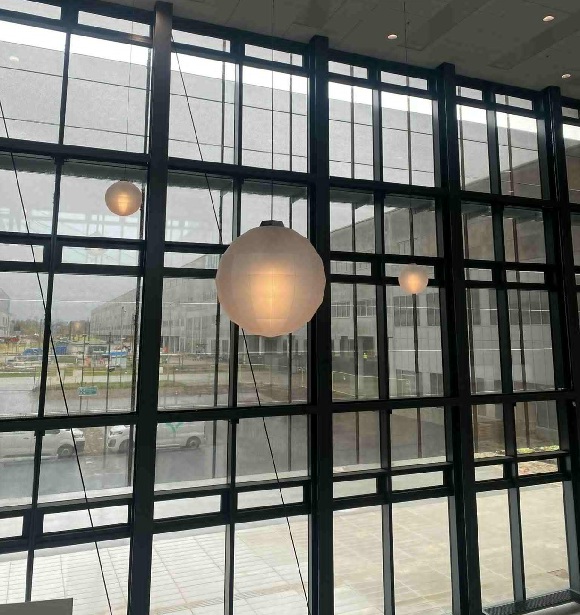
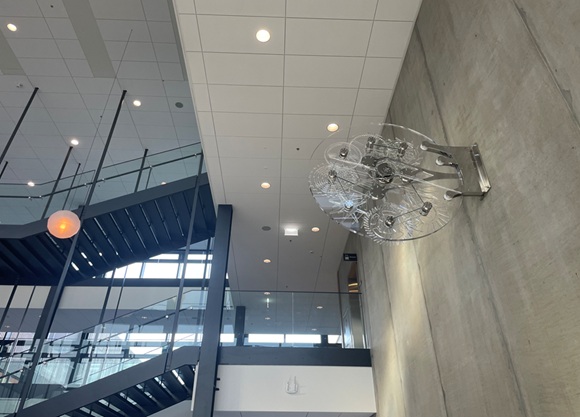
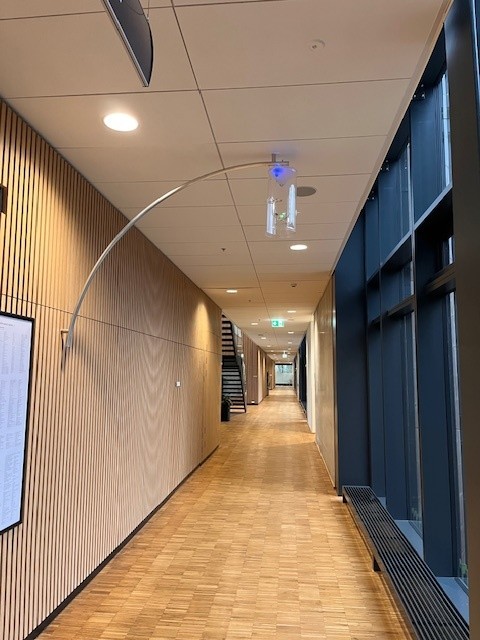
In the transition zone between SDU and the New OUH, French artist Philippe Parreno has created a work that is constantly changing.
The artwork Clock and Moving Lamps consists of moving lamps and a large clock. The light elements shift in choreographed patterns, making the space feel both familiar and new at the same time.
The piece illustrates the connection between the two institutions and challenges the boundaries between reality and imagination.
About the artist:
Philippe Parreno lives in Paris. He works across film, sound, light and installation, and is known for creating works that evolve over time.
He is internationally recognised and has exhibited at, among others, Tate Modern in London and MoMA in New York.
The Axis – Simon Starling
Simon Starling, an English artist based in Copenhagen, is behind the artwork Floral Medicine, which unfolds in several locations across the Faculty of Health Sciences and the New OUH.
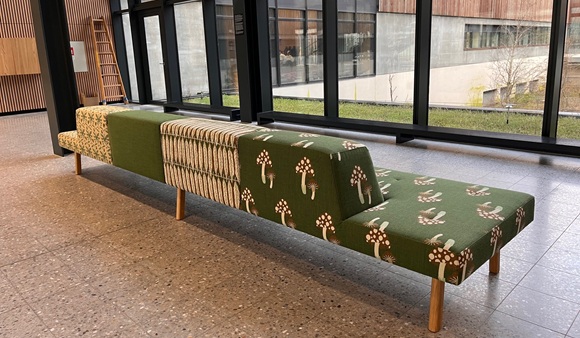
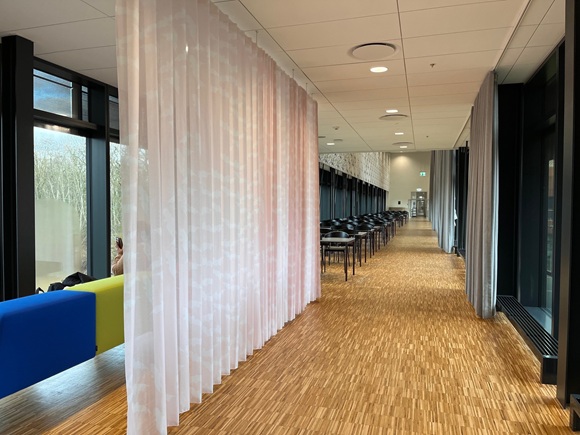
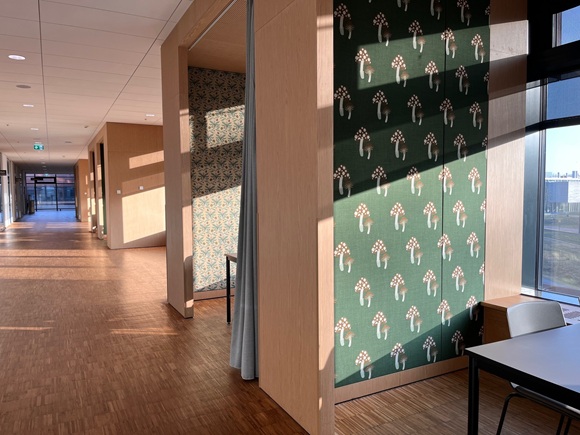
The piece explores nature’s dual force – both healing and poisonous – through patterns on furniture and textiles, as well as gardens featuring carefully selected plants.
At the Department of Forensic Medicine, for instance, you'll find a closed Deadly Garden and a sofa patterned with toxic plant motifs. The garden is not yet completed, so the work has not officially been handed over to SDU.
The textile designs also adorn study booths along the Axis, while the Wildlife Corridor features the curtain Bat Curtain and the sofa Green Birds Sofa.
About the artist:
Simon Starling has exhibited globally and regularly takes part in biennales.
He won the Turner Prize in 2005 with the work Shedboatshed – a shed he transformed into a boat, sailed up the Rhine, and then reassembled as a shed for an exhibition in Basel.
Read more about Simon Starling’s artwork at the Faculty of Health SciencesMain entrance, Stenten S – Monica Bonvicini
Suspended above the main staircase at entrance Stenten S is the light sculpture Nocturnal Bang, created by artist Monica Bonvicini.
The piece can be understood as an oversized theatrical chandelier, visible both from outside and from various vantage points within the building.
With its location at the entrance, the work marks a central hub between the existing SDU and SUND buildings and also serves as a landmark for visitors.
Its placement at the entrance marks a key junction between the existing SDU campus and the new Faculty of Health Sciences building, while also acting as a landmark for visitors. The light installation is on two hours per day.
.jpg?la=da&h=571&w=580&hash=96DDF2529F238422B97C481420814CAC)
About the artist:
Monica Bonvicini lives and works in Berlin.
She is known for her critical and humorous works that explore the relationship between architecture, gender, the body, surveillance and power.
She has received numerous awards and is renowned for large-scale public sculptures, such as RUN in London and She lies, which floats on the water outside the Oslo Opera House.
Read more about Monica Bonvicini’s artwork at the Faculty of Health Sciences
Corridors and the Axis – FOS
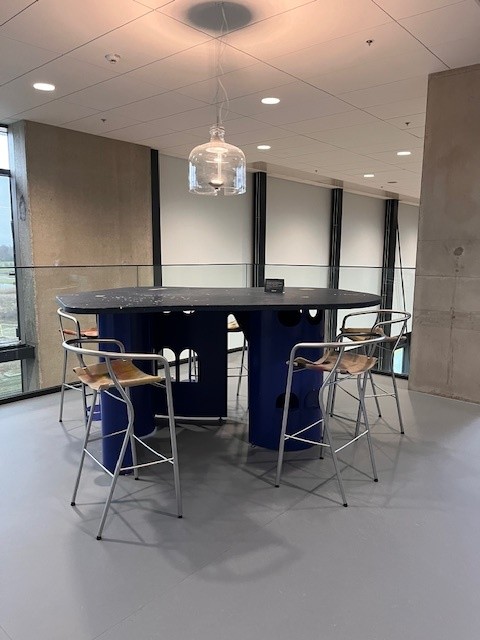
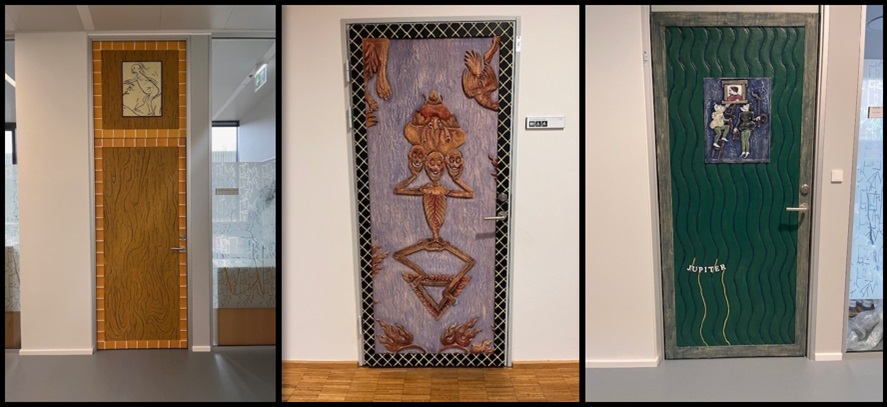
Danish artist Thomas FOS Poulsen is behind the work Message above, thoughts on the ground, which appears in several locations at the Faculty of Health Sciences.
He has designed unique doors along the first and second-floor corridors and created colourful tables, chairs and lamps in organic shapes for the Axis.
In front of auditoriums 300 and 301 hangs a bell, which is also part of the installation.
About the artist:
FOS lives in Copenhagen and works both nationally and internationally.
He presented the installation Osloo in the Danish Pavilion at the Venice Biennale in 2011, and has, among other projects, redesigned Mændenes Hjem (The Men's Home) in Vesterbro together with Kenneth Balfelt.
FOS often works in the intersection between art and design.
Read more about FOS’ artwork at the Faculty of Health Sciences
Ground floor corridor – Cory Arcangel
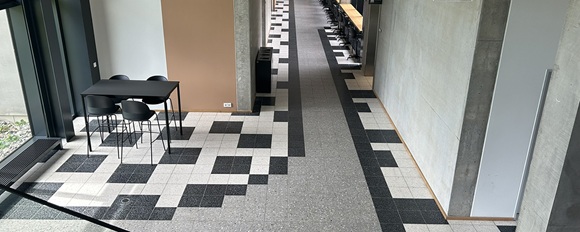
On the ground floor of the Faculty of Health Sciences, American artist Cory Arcangel has decorated floor surfaces with striking black-and-white patterns.
The designs originate from a digital painting programme from 1984 and evoke early computer graphics as well as traditional chessboards.
The work, titled inft fll, connects the digital and the physical and acts as a visual archive of the early computer era. Its clean, precise aesthetic also draws on minimalist art.
About the artist:
Cory Arcangel lives in Oslo and New York.
He is a pioneer in art using social media and Web 2.0, and is interested in how digital phenomena emerge – and quickly become outdated.
In 2011, he became the youngest artist since Bruce Nauman to have a solo exhibition at the Whitney Museum in New York.
Read more about Cory Arcangel’s artwork at the Faculty of Health Sciences.
Communicating the art at the Faculty of Health Sciences
- An art communication agency is producing professional photographs and texts about each artwork and artist.
- The material will be compiled in a digital catalogue to be launched in 2026.
- In 2027, a map of all artworks at both SDU’s Faculty of Health Sciences and the New OUH will also be published.