It all began with medicine – 60 years of medical education at SDU
The University of Southern Denmark is celebrating its 60th anniversary. To mark the occasion, throughout 2026 we will be focusing on some of the key themes that have their roots in 1966 and which still characterise the university today. This time, the focus is on medicine. In fact, it was the need for more doctors that sparked the establishment of the university. 60 years on, medicine and health continue to play a central role – now with new opportunities for research and innovation at the intersection of medicine and technology.
In the late 1950s, there was a serious shortage of places on medical degree programmes in Copenhagen and Aarhus. Denmark needed more doctors, and in 1962 the Danish Parliament therefore decided to establish a new Faculty of Medicine in Odense. The plans grew rapidly. Two years later, the ambition was no longer merely a faculty of medicine, but an entirely new university.
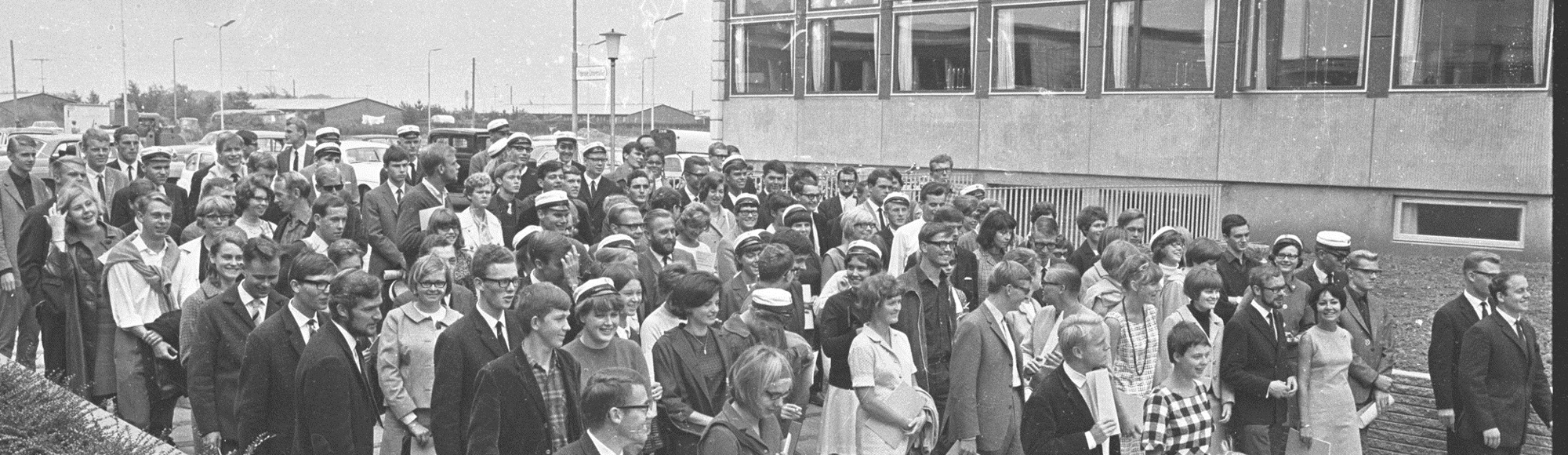
When the University of Odense opened its doors in 1966, medicine was therefore part of it right from the start. A third of the university’s first 180 students were studying medicine.
What began as a response to a shortage of student places and doctors thus also marked the start of the university we know today.
From 60 medical students to nearly 400 new ones a year
The first medical students began their studies in modest circumstances at a university that was itself still under construction. The medical programme was subsequently relocated to J.B. Winsløws Vej, close to Odense University Hospital, whilst the majority of the university moved to Campusvej.
Since then, both the programme and the university have grown significantly. Today, medicine remains one of SDU’s largest degree programmes, with just under 400 new medical students expected to enrol on the bachelor's degree programme each year.
In 2022, the first students began the regional master's degree programme in medicine in Esbjerg. From the outset, the programme was developed in close collaboration with the regional health service, including through a ‘home department’ concept, whereby students are attached to the same clinical department for an extended period.
Since then, the next step has been taken with the establishment of a bachelor's degree programme in medicine in Esbjerg. This means that the entire medical degree can now be completed in the city.
In this way, history is repeating itself to some extent. Just as the establishment of the medical programme in Odense was originally based on a specific community need, the programme in Esbjerg is intended, amongst other things, to help train and retain more doctors in the southern and western parts of the Region of Southern Denmark.
When the programme nearly closed
At SDU’s 50th anniversary in 2016, a number of stories looking back at the past were also shared. Among other things, one could read the story from the late 1980s, when the medical programme was actually on the verge of closure.
However, this was averted thanks to a major and protracted protest campaign by both students and staff, led by Dean Mogens Hørder. And in 1989, the then Minister for Education, Bertel Haarder, was convinced. The medical programme at the University of Odense had proven its effectiveness and great importance not only for Funen but also for South and South Jutland. ‘You’re too good to close down!’, he declared in the Folketing.
Read the full story of how the students and staff saved the medical school (in Danish)
From a university next to the hospital to a university and hospital under one roof
The relationship between the university and the health service has been close throughout SDU’s history. But in Odense, that connection is currently taking on a whole new physical form.
With Nyt SUND, the majority of the Faculty of Health Sciences has moved from the area around J.B. Winsløws Vej to Campus Odense. The faculty building, covering approximately 50,000 square metres, was opened in 2023 and acts as the link between the existing SDU and Nyt OUH.
Once Nyt OUH is completed, the hospital and the university will be directly physically connected. Together, New OUH and SDU will be integrated into a building complex spanning more than 500,000 square metres, allowing direct movement between the university, health science research environments and the hospital. The merger will also make the complex one of the world’s largest buildings.
This physical proximity is intended to make it easier to forge new collaborations between researchers and clinicians and to shorten the gap between new knowledge and its application. One of the aims is to strengthen translational research, where findings from laboratories and research environments can be tested and translated into clinical practice more quickly.
In this way, the link between the university and the hospital also represents a modern continuation of the idea from which the university was born: education and research must be able to make a tangible difference to the healthcare system.
When doctors, engineers and robotics researchers come together
Today, health research also extends far beyond the traditional medical disciplines.
Artificial intelligence, robotics, sensors and new diagnostic methods are increasingly becoming part of both research and treatment. At SDU, doctors, engineers, physicists and computer scientists, amongst others, are working together on new health technology solutions.
This development has gained further momentum with MedTech Odense, which SDU, the Region of Southern Denmark, OUH and Odense Municipality established as a joint strategic initiative in 2024.
The aim is to create a strong environment where researchers, clinicians, businesses and other stakeholders can develop, test and implement new health technologies in a setting that closely mirrors the real-world conditions in which they will be used.
Joint research and innovation environments already exist between SDU and OUH in areas such as artificial intelligence, medical technology and clinical robotics. Furthermore, MedTech Odense has earmarked significant funding in both 2025 and 2026 for projects designed to bring new ideas from research closer to clinical practice and application.
In this way, the university’s breadth becomes a strength in itself. What began in 1966 with medicine and the humanities is today a university with five faculties, where new breakthroughs in the field of health can emerge from the intersection of, for example, medical science, engineering, natural sciences, computer science and social sciences.
The University of Southern Denmark’s 60th anniversary
To mark the anniversary, a series of articles with a historical perspective will highlight defining characteristics of the University that has developed over 60 years – from its first facilities in Odense to a multi-campus university with regional and international impact.
