The Student’s Column
SDU’s student democracy problem
SDU’s student democracy situation is characterised by a number of challenges – dominated by an embarrassingly low voter turnout everywhere. I believe that the student democracy is failing because of an unsuitable system, and I propose a two-step solution.
The student democracy at SDU is challenged, to say the least. In the 2024 SDU elections, I was elected to both the Academic Council at the Humanities and the University Council, but in both cases with incredibly low voting percentages – 7.15 per cent at the highest – which convinced me that our current system is simply not working as intended. A student democracy is supposed to be a representative democracy – but can you really call it a representative democracy with such a low voter turnout?
I do not think so, and therefore I propose two ‘radical’ changes to our current system.
Before that, however, I will briefly outline the status quo, as the low voting percentage could also indicate a lack of transparency and – as a result – understanding.
At the moment, SDU uses an election system similar to that used in parliamentary elections, for example, in which individuals run on a list – usually a party-based list. At SDU, the ‘parties’ are the various student political organisations, such as Syddanske Studerende (Students of Southern Denmark) (SDS), Frit Forum (Free Forum) and Konservative Studerende (Conservative Students). In addition, there is the organisation Syddansk Universitets Studenterråd (the Student Council of the University of Southern Denmark) (SUS). Like SDS, SUS calls itself a student council and seems to consist primarily of dissidents excluded from SDS. I was elected through SDS but I am not active in the organisation in any other way. Although you can also create your own list as an individual and run as an ‘independent’, the first three organisations mentioned above hold most of the seats in various collegiate bodies, for which they compete every two years.
So this is the current system; but by all accounts, it is not working as intended. Therefore:
1st change – One student council:
In my utopian mind, a ‘student council’ should represent all students across all other factions – similar to the student councils in Danish upper secondary schools. It seems counter-intuitive that such an organisation stands for election in direct opposition to larger or smaller groups of students. It would be equally strange if, in the EU elections, for example, you could vote for either SF (Socialistisk Folkeparti – the Green Left) or the entire Danish Parliament, of which SF is a part. In the same way, an actual student council would include and represent all students – across the political spectrum. I would argue that SDU does not actually have a student council, although it houses two organisations that refer to themselves as such. With the current regulations, anyone can form an organisation and call it a ‘student council’. In principle, me and two of my best drinking mates could pop down to Sir Club tomorrow, write a few quick articles of association and claim that we represent all of the 25,000+ students at SDU. Of course, our claim would not be true in any way – but we could do it. I suggest that SDU change this as soon as possible and create a real student council instead that can speak on behalf of the students. I have outlined the following model, which is based on what is done elsewhere and is basically just an extension of the student councils in upper secondary schools:
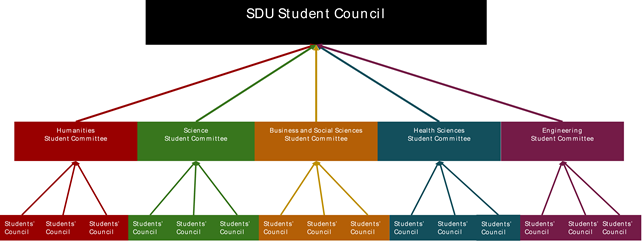
As the model shows, I propose that we base the new system on the existing students’ councils that represent the individual study programmes. In the new system, each students’ council would appoint two of their members to a kind of ‘student council’ at their faculty – in the model, these are called ‘committees’. The Humanities Student Committee (HuSK) would thus actually represent all the study programmes at the Faculty of Humanities (HUM). When something important happens in the Academic Council (AR) at HUM in the future, as a student representative, I would be able to discuss the matter in HuSK. Following that, I could actually speak on behalf of the students at HUM in the AR. The students’ voices in various councils would finally become representative and could truly be said to reflect the entire spectrum of students’ opinions.
Each committee would appoint three of their members to a Student Council, which would then directly speak for and represent all students at SDU. The members of the Board and of the University Council would thus be able to discuss and debate matters there – and the members of the Student Council would be able to discuss things with their base in the faculty committees, which would ensure a representative clarification of the issues.
2nd change – abolish SDU elections for the students:
I have already explained how little support there is for our current electoral system; and therefore, I suggest that we do away with it altogether – at least for the students. An election with such a low voter turnout smacks of democratic dysfunctionality and in no way achieves the representativeness which it aims to provide. Since we are setting up representative committees and student councils anyway, I propose that we give them the right to appoint members to the various councils and bodies, as is the case in the Danish upper secondary schools. Therefore, I propose the following model:
|
Student politics level: |
Appoint members to: |
|
SDU Student Council |
University Council and Board of Directors |
|
The committees |
Academic Council |
|
Students’ councils and similar |
Study boards |
In this way, all student representatives in all councils and bodies would be elected by all the students whom they represent. All of the students would have the opportunity to participate and both transparency and representativeness would be greatly increased.
This is my suggestion for a solution to SDU’s rather serious student democracy problem: to do away with the current, dysfunctional system; to scrap the current election model; and to introduce one real student council and five committees – sanctioned by the Rector and with the right to appoint members to all relevant bodies and councils.
Sebastian Kirkgaard
5th semester student on the History programme Chair of the Student Council Member of the Study Board and the Academic Council for the Humanities Vice Chair of the University Council