Warrior Woman
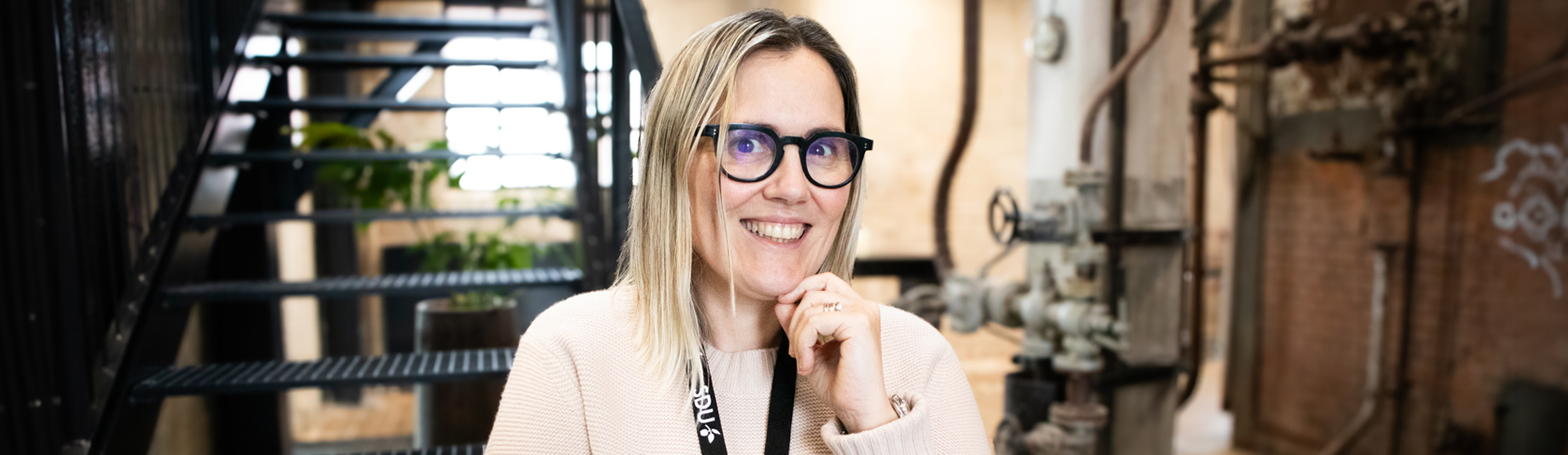
Portrait of Professor Valentina Lenarduzzi.
I meet Professor Valentina Lenarduzzi at the current location of SDU Vejle. Though ambitious plans have since been announced for the new campus on the harbour front, I am glad I met the Italian professor while she still has her office in the raw, industrial surroundings of Spinderihallerne.
Because the setting feels fitting for something still taking shape. For a new academic adventure gradually finding its form.
For a little while longer, SDU Vejle lives inside an older body: a former industrial building in the middle of Vejle, where brick, iron and high ceilings carry the memory of another kind of labour. It is not polished in the traditional university sense. It is rawer than that. More in motion.
And that is exactly the right way to describe Valentina.
Because Valentina is not a person shaped by ease, inheritance or a smooth academic path. She is shaped by shifts, resistance and difficult choices made early and carried through without self-pity. She has the kind of presence that suggests both discipline and velocity. There is elegance in her, but not softness. Or rather: not softness first. The first thing one notices is force.
She laughs easily but speaks like someone who has spent most of her life moving forward against friction.
“I didn’t select this job,” she says. “The job selected me. And then I decided to do it in the best possible way.”
That sentence says more about her than any formal CV can.
Because on paper, her career looks almost improbably efficient: PhD, postdoc, assistant professor, associate professor, professor. A steady climb. But the climb was not straightforward. She did not begin in computer science. She came to it late, from environmental science and engineering, after already changing direction more than once. She arrived in software engineering, by her own account, as a matter of realism.
And then she decided she would not merely adapt. She would excel.

A child of art and discipline
Valentina grew up near Como in northern Italy, though her family roots stretch further east, towards the Alps, where her father’s family comes from.
Her childhood was shaped by strong aesthetic influences. Her father was both a high school teacher and an artist. Her mother worked as a fashion designer.
As a girl, Valentina trained in classical ballet and seriously wanted to become a ballerina. That dream ended when problems with her foot made it impossible. But even the abandoned dream left its mark.
Ballet is not only beauty. It is repetition, pain, standards, precision. The body trained to continue when it would prefer to stop. Many of those qualities still seem to shape her approach to life today.
So does the artistic side. She paints and draws, often in black and white. She speaks vividly about shadow, structure, depth and visual balance. She likes strong forms and talks about style with the same seriousness she brings to research: not as decoration, but as expression, method and discipline. Again, discipline and attention to detail emerge as recurring themes.
”Ambition drives me. And I have never been scared of what others think of me.
The turn that became a test
Valentina’s route into academia was not a straight path from the beginning.
In high school she had a special interest in chemistry and went on to complete both her bachelor’s and master’s degrees in environmental science. Later came a second master’s degree in environmental and civil engineering at Politecnico di Milano. At that point, a different life still seemed possible. But timing mattered. Labour market conditions in Italy were poor and jobs were hard to find. A secure future in her original field did not present itself.
So, she shifted again. The move from environmental science into engineering had already been, as she puts it, one major shock. The move from that world into computer science was yet another.
“I started almost from scratch,” she says.
She entered a PhD in empirical software engineering without the conventional background of those around her. In Italy, the standard PhD runs for three years. She took an extra year at the beginning to close the gaps, study intensively and build the foundation she knew she lacked.
That part matters, because many people tell stories of reinvention as if reinvention is glamorous. In reality, reinvention is often a humbling experience. It means being late. It means not knowing what others already know, feeling behind and having to move faster simply to enter the same race.
Valentina does not romanticise any of that:
“I was behind others in time, so I knew I had to move faster. Speed means choices. Speed means sacrifice.”
This is where things get even deeper and detirmened. She did not enter the field as the gifted child prodigy who always knew exactly where she belonged. She came into it as someone who saw a mountain in front of her and decided to climb anyway.
“If there is a mountain in front of you, you prepare, you study the terrain, and then you climb.”
She returns to that image more than once. Not casually, but as a philosophy.
You don’t wake up one morning and decide to climb Everest. You study the route. Learn from those who have done it before. Train your body and your mind. Understand the risks. Then, when the climb begins, you keep going.
“Every mountain is difficult in a different way,” she says. “Every mountain has risks. But if you want to reach the top, you keep moving.”
Ego — and the refusal to apologise for ambition
There is a moment in our conversation when I ask Valentina what drives her, and she answers without hesitation and with a crooked smile on her lips:
“It’s ego.”
Many people would soften that answer. She refuses to do so. So many men trough history have been driven by this – so why can women not be? This was not her own words – but the underlining and admirable feminism shines through her honesty.
Basically, it’s about: ambition, achievement, competitiveness, the desire to become very good at something and to see concrete proof of that effort in the world – and not to apologies for any of it.
It’s about the pride of being named among highly productive young researchers and experience real satisfaction about PhD students succeeding with strong journal publications. Valentina likes results, standards and forward motion.
And she sees no point in pretending otherwise.
“People expect a noble answer,” she says. “But I prefer the honest one: ambition drives me. And I have never been scared of what others think of me,” she says again with a winning smile and a stern look in her eyes.
Still, she draws a sharp line between ambition and destruction.
“I never wanted to win by damaging others. I wanted to succeed through work, discipline and results.”
A defining ethical statement. Valentina’s ambition is unapologetic, but it is not cynical. She wants to climb — but not by kicking others down the mountain.
Building things that last
When Valentina explains her field to people outside software engineering, she reaches for a metaphor from construction.
In every city, she says, there are visionary architects — the ones who design spectacular buildings, who want futuristic lines, memorable forms and statement pieces. In software, too, there are people who want to create dazzling structures, elegant architectures and systems that win admiration.
But someone must also live with the building afterwards.
Someone must ensure that it can actually be constructed, maintained, repaired and adapted over time. Someone must think about weather, materials, stress, use, standards and the slow wear of reality.
That is where she places herself.
Her work is about software quality, sustainability and maintainability — not only building something impressive now, but ensuring that it still works ten, twenty or fifty years from now. It is about what survives contact with time.
In that sense, the metaphor goes beyond research. It feels personal too.
Valentina is not interested in brilliance that collapses. Not in systems. Not in careers. And certainly not in people.
”If there is a mountain in front of you, you prepare, you study the terrain, and then you climb.
The survivor’s intelligence
Again and again, what emerges in her story is not only determination, but adaptation.
She describes herself as someone who changes quickly, finds solutions everywhere and adapts “like a chameleon.” The image is revealing. Hers is not a rigid strength in the simple sense. It is strategic strength. She learns terrains. She reads situations. She survives by understanding what a given environment demands and then meeting it fully.
And yet there is rigidity too — or at least she admits as much. She says she tends to see things in black and white and is still learning to see more shades of grey. Friends have called her rigid. She does not really deny it.
“If it must be done in that way, it must be done in that way.”
But even that has a logic behind it. For her, rigour is a form of respect: respect for quality, for method, for the work others did before you, and for the fact that knowledge is part of a chain and that one is responsible for one’s piece of it.
That way of thinking also connects to something else she values intensely: gratitude.
“No one succeeds alone,” she says. “I remember every person who helped me.”
She talks about loyalty without irony. About not forgetting who opened doors, who offered support, who trusted her and who made something possible. Her parents. Her PhD supervisors. Close collaborators. Her best friend. Her husband.
She speaks of gratitude not as politeness, but as a moral quality.
It is part of the warrior quality too, in its own way. She is not a lone-wolf type. She believes in alliances. In earned loyalty. In remembering who stood with you on the climb.
Her husband, Davide Taibi, is part of her story because their careers have been intertwined for years. They have moved internationally, supported each other professionally and made strategic choices together.
But Valentina is very clear about the terms on which that story should be told.
“We think, design and act as a team,” she says. “Without Davide I would not be here. But without me, Davide would not be here either.”
That is enough, and perhaps the strongest way to leave it. Not as a story of one person following another, but of two intellectually ambitious people whose paths have strengthened each other — without reducing her to an appendix in someone else’s career.
The important fact is not that he is in the picture. The important fact is that she knows exactly who she is in it.
”Technology should assist the human mind, not replace it.
Technology should assist the human mind, not replace it
If Valentina can seem hard on herself and others, it is partly because she believes the stakes are real.
Her concern about AI is not fashionable alarmism, nor technophobic resistance. It comes from a much older principle: powerful tools require understanding, discipline and judgement.
“AI can be useful,” she says. “But using powerful tools without understanding them is dangerous.”
What worries her most is not the technology itself, but uncritical dependence. Students using tools such as ChatGPT to generate code they cannot evaluate. People outsourcing thinking before they have built the competence needed to judge whether the output is right or wrong. A culture increasingly attracted to convenience and less committed to mastery.
“Technology should assist the human mind, not replace it.”
Her frustration is especially sharp when she talks about students losing the desire to push beyond minimum requirements. She wants more ambition from them, more competition, more hunger to improve, more willingness to see beyond the hill directly in front of them.
In that sense, her concerns about AI are tied to the rest of her worldview. She distrusts anything that weakens discipline, erodes judgement or invites people to skip the difficult part where character is formed.
Something that remains
Back in Spinderihallerne, surrounded by the exposed history of work and reinvention, Valentina seems entirely in place.
SDU Vejle is still new. The permanent campus at the harbour lies ahead. The environment is still forming. But that does not trouble her. If anything, it seems to sharpen her focus.
She speaks about wanting to help build something that lasts here: not a brief moment or a temporary surge of attention, but something consolidated, useful and durable. Something that remains for the people who come after.
That desire feels connected to everything else in her story — the artist’s eye, the climber’s will, the survivor’s instinct and the scholar’s discipline.
She once wanted to be a ballerina. Instead, she became something harder to define — and perhaps harder to become: a builder of lasting things.
Not because the path was given to her. Because it wasn’t.
And because, when the mountain appears, she keeps climbing. As a warrior she moves into unknown territory without fear, because she is prepared for anything.
Meet the researcher
Valentina Lenarduzzi is a professor at the Department of Mathematics and Computer Science at the Faculty of Science at the University of Southern Denmark. She is also Vice Head of the department’s Artificial Intelligence, Cybersecurity and Programming Languages section.