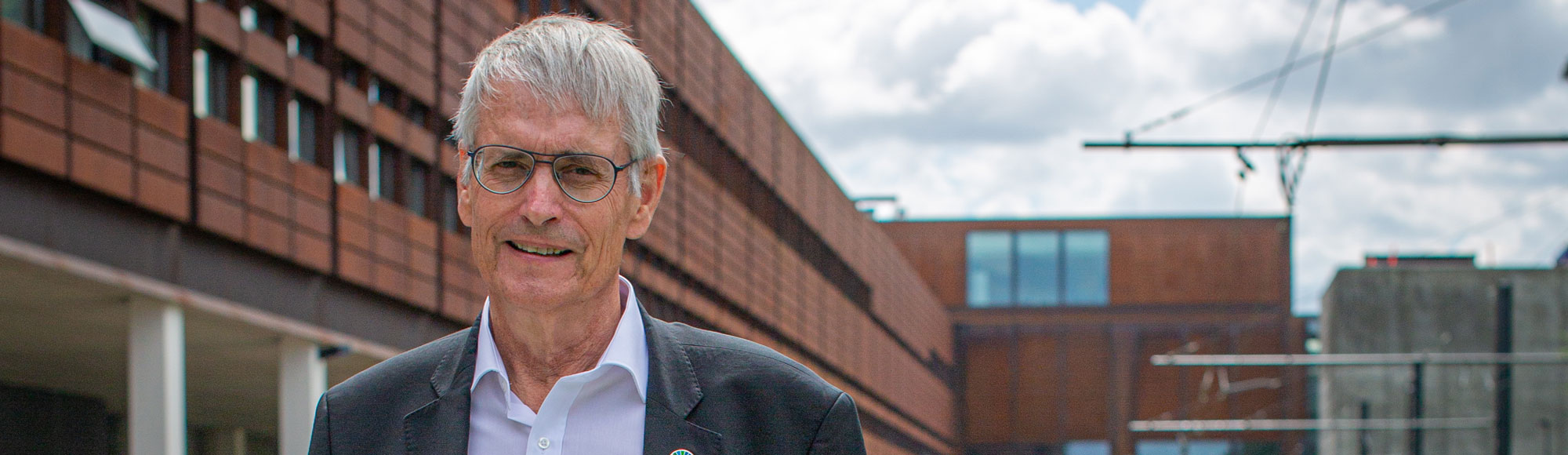
Ole Skøtt looks back on 18 years of development at SUND
A few months before his retirement, Ole Skøtt takes stock of a faculty that has grown in size, academic scope and collaboration with the healthcare sector.
Nyt SUND as a framework for development
– My time as dean has been shaped to a great extent by the establishment of Nyt SUND. The idea for the new building came about just after I had taken up my post in 2008. I was involved throughout the entire construction process, and the resulting 50,000 m² facility will form the basis for the development of the Faculty of Health Sciences in Odense, says Ole Skøtt.
There are great expectations for the physical connection of SDU with the University Hospital, and Nyt SUND’s location in close vicinity to the other faculties has similarly enhanced cross-disciplinary collaboration opportunities.
– The proximity to other faculties, in particular the Faculty of Engineering and the Faculty of Science, has opened up new opportunities for interdisciplinary collaboration, he says.
From a small faculty to a broad academic scope
When Ole Skøtt took up his post as dean, SUND was a considerably smaller faculty than it is today.
– Our turnover was around DKK 400 million. In 2025, SUND generated a turnover of over DKK 1 billion. New departments have been established, staff numbers have increased and new degree programmes have been developed.
The expansion has also required a broader management structure.
– When I became dean, many decisions were concentrated around the dean. Today, the faculty management is anchored more broadly and this makes the organisation more resilient, says Ole Skøtt.
There have also been significant developments in the area of education. In 2010, SUND established the Department of Psychology and the first students were admitted to the bachelor’s degree programme in the same year. Since then, the department has expanded and it now includes master’s degree programmes, research and, as of last year, a degree programme in Psychology in Esbjerg.
At the same time a bachelor's and a master's programme in Medicine have been established in Esbjerg. In 2020, SDU moved into a new 7,500 m² building adjacent to UC SYD on Degnevej in Esbjerg. In 2025, SUND celebrated the graduation of the first cohort of doctors in Esbjerg.
– The master’s degree programme in Esbjerg has evolved into an innovative teaching and learning environment in which new approaches have been tried out. The system of referring departments, which means that students are assigned to a specific department one day a week, is one example of this, and the other medical degree programmes in Denmark are taking an interest in this model, says Ole Skøtt.
All aspects of health
Today, SUND has a broad education and research profile which in addition to medicine and psychology includes public health science, clinical biomechanics, pharmacy, audiology, and sports and health. In this way, the Faculty focuses on health in a broad sense – from prevention and treatment to rehabilitation, physical activity and mental well-being. At the same time, Ole Skøtt points out that medical research at SDU performs well in research analyses in terms of research impact and the number of publications.
According to Ole Skøtt, however, the strong performance of the research has always been related to a broader purpose.
– Since I took up my post, our overarching vision has been to improve people’s health. Our purpose is not just to generate new knowledge for publication in recognised scientific journals. Of course, It is one of our purposes, but we are also gratified when our interdisciplinary research is quickly of benefit to the public and the patients, he explains.
Central posts and committees
This ambition has also shaped the development of disciplines that now play a central role in the healthcare system but which previously had a weaker academic foundation.
– Many healthcare services are provided by members of professions that have not previously had a strong foundation in research at universities. We have therefore established clinical nursing, midwifery, occupational therapy and physiotherapy as areas of research and education. We have developed master’s programmes, laid the foundations for PhD programmes and established research environments, some of which are now among the strongest at the University, he says.
– At first, some people were rather sceptical about nursing research and physiotherapy research, for instance. But for us, it was a natural consequence of the mission we had set for the Faculty. If we want to improve people’s health, we must also develop knowledge in the areas in which healthcare services are actually provided.
This development is in line with SDU’s overall strategy of creating value for and with society. The next step is to offer Health Economics as a new track and to work towards establishing degree programmes in Dentistry and Dental Hygiene at SDU.
– Establishing the best Dentistry and Dental Hygiene programmes in the country is also an essential part of the academic development, he emphasises.
Collaboration requires leadership
According to Ole Skøtt, collaboration across SUND’s many disciplines is a management task.
– I have always regarded bringing people together across different groups as an important management task. If you don’t do anything, silos will be formed – of their own accord. But if you want to maintain cross-disciplinary collaboration, it requires ongoing attention from management, he says.
This applies internally, across faculties and in our collaboration with the university colleges.
Closer to the healthcare system
The collaboration with the regions and with hospitals has been crucial to SUND’s academic development. Shortly after Ole Skøtt became dean, the role of university hospitals in particular changed significantly.
– This happened due to the publication by the Danish Health Authority of the first comprehensive speciality plan. As a result, research is no longer considered an expensive hobby: it is a central part of running a hospital, Ole Skøtt emphasises.
This had a major impact on OUH.
– When I started at SDU in 1995, not many of the hospital’s departments were at the level of a university hospital. This has changed completely. Today, standards are very high in almost every specialty, he says.
The regional hospitals have also taken on a more prominent role in research through the degree programme in Medicine based in Esbjerg and the cross-disciplinary collaboration regarding medical students.
– When we established the regional degree programme in Medicine, it also provided an opportunity to strengthen the regional collaboration on research and education. We proposed that the hospitals that accept medical students could join the University Hospital of Southern Denmark – the common framework for collaboration between SDU and hospitals in southern Denmark – and commit to a stronger research agenda, explains Ole Skøtt.
– The Region agreed and the hospitals outside of OUH have committed to spending three per cent of their operating costs on research – the same percentage as OUH. This has strengthened research, education and recruitment.
A vision to be carried forward
Ole Skøtt will step down as dean at the end of August. His hope for the future is that SUND will remain true to the vision that has guided the Faculty throughout his tenure as dean.
– I very much hope that our long-term vision will be carried forward: that we are here to improve people’s health. It would be a shame to let it go, because people identify with this vision and it makes sense across a wide range of disciplines. The vision has served as a common guiding principle for the Faculty and for our work in research, education and collaboration with the healthcare sector, Ole Skøtt explains.
Background
- Born on 18 July 1955 in Viborg
- Graduated from Herlufsholm in 1974
- Master’s degree in Medicine from the University of Copenhagen in 1982
- Doctor of Medical Science from the University of Copenhagen in 1989
- Professor of Physiology at SDU in 1995
- Head of Department at SDU in 2006
- Dean of the Faculty of Health Sciences at SDU in 2008
- Interim Rector of SDU for four months in 2021