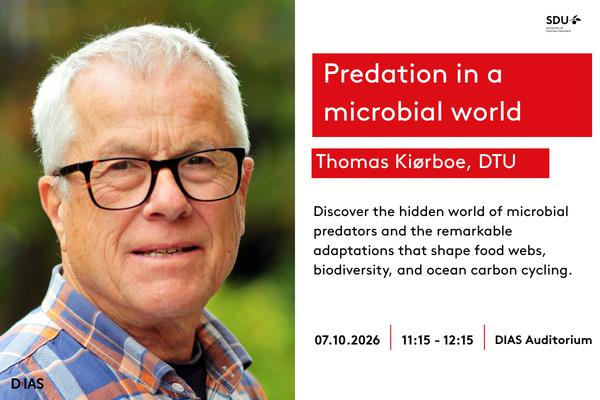
The role of predation in the microbial world is like that in the macroscopic world: it makes energy flow to form food webs, regulates prey population, and is a source of biodiversity. However, mechanistically, predation operates very differently since in the microbial world viscosity impedes predator-prey contact, there is no vision to facilitate prey (and predator) perception, and observed behaviours are often counterintuitive. I will demonstrate how planktonic predators, from few micron-sized nanoflagellates to mm-sized copepods, have overcome the impeding effect of viscosity by a fascinating diversity of adaptations, and how microbial predators have balanced the fundamental problem of eating without themselves being eaten. I will show how this trade-off has driven an evolutionary arms race between diatoms and copepods with important consequences for the biological carbon pump. Finally, I will describe how the functional diversity of foraging in flagellates provides a new lens through which to explore early eukaryotic evolution. The presentation will be light on physics and rich in videos and animations.
About the speaker
Thomas Kiørboe is a professor of Biological Oceanography at DTU Aqua. He has been the founder and leader of VKR centre of excellence Centre for Ocean Life (2012-2024) (www.oceanlifecentre.dk) and leader of a Research network (Trait-based plankton ecology, 1993-2013) supported by the Danish Research Council, and head of section at DTU Aqua (2008-13). His research interests span plankton ecology and biogeography, small-scale biological-physical interactions, microbial ecology, trait-based ecology, marine snow, and early eukaryotic evolution. He has been a visiting professor at MIT, UC Berkeley, and CSIC in Spain, and an adjunct professor at SDU (2006-2010). He is an Elected Fellow of Royal Danish Academy of Science and Letters and The Danish Academy for Technical Sciences, and the recipient of multiple national and international awards and accolades, including the AG Huntsman award and the Carlberg Foundation research prize.
The event is organized by Donald Canfield
- Arrangør: Danish Institute for Advanced Study - DIAS
- Adresse: Campusvej 55, 5230 Odense M
- Tilføj til din kalender: https://eom.sdu.dk:443/events/ical/25007a72-dc4c-4073-a704-8c46b03f84a0