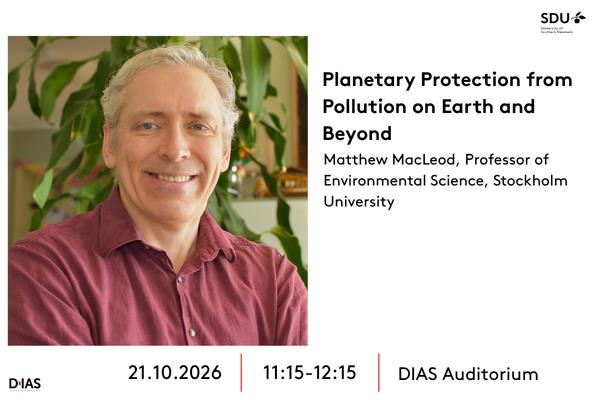
Humans have introduced a huge array of novel chemical and material pollutants into the Earth system, and continue to do so at an ever-increasing scale. Humanity’s pollution disrupts Earth system processes, and the stream of novel pollutants flowing into Earth’s environment poses a constant threat of new planetary-scale impacts. This lecture provides a summary of nearly 15 years of evolution of ideas about how to confront risks and threats from planetary-scale pollution on Earth, and about a new initiative to extend those principles to protection of the moon, Mars and other celestial bodies where humans explore, visit, and may eventually colonize.
About Matthew MacLeod
Matthew MacLeod is Professor of Environmental Science at Stockholm University, Sweden, and Deputy Dean of Earth and Environmental Science. He is a Fellow of the Royal Society of Chemistry (FRSC) and is currently Sweden’s “Designated Expert” on Persistent Organic Pollutants for the Arctic Council’s Arctic Monitoring and Assessment Programme (AMAP). He holds a Bachelor’s degree from the University of Victoria (Canada), and Master’s and PHD degrees from Trent University (Canada). Prior to moving to Sweden in 2010 he was a post-doctoral researcher at the Lawrence Berkeley National Laboratory (USA) (2002-04) and a Research Group Leader at the Swiss Federal Institute of Technology (ETH) in Zurich, Switzerland (2004-10). Professor MacLeod uses mathematical models and data analysis to study the factors that control human and environmental exposure to environmental contaminants, and the links between the three dimensions of the “triple planetary crisis” of pollution, climate change and biodiversity loss. The goal of his research is to build a quantitative understanding of humanity’s impacts on the Earth system, and to develop practical tools and guidance to support rational decision-making.
The event is organized by DIAS Chair Zhanyun Wang
- Arrangør: Danish Institute for Advanced Study (DIAS)
- Adresse: Campusvej 55, 5230 Odense M
- Tilføj til din kalender: https://eom.sdu.dk:443/events/ical/2806cc4c-e443-4111-8f9a-e6f282265df8