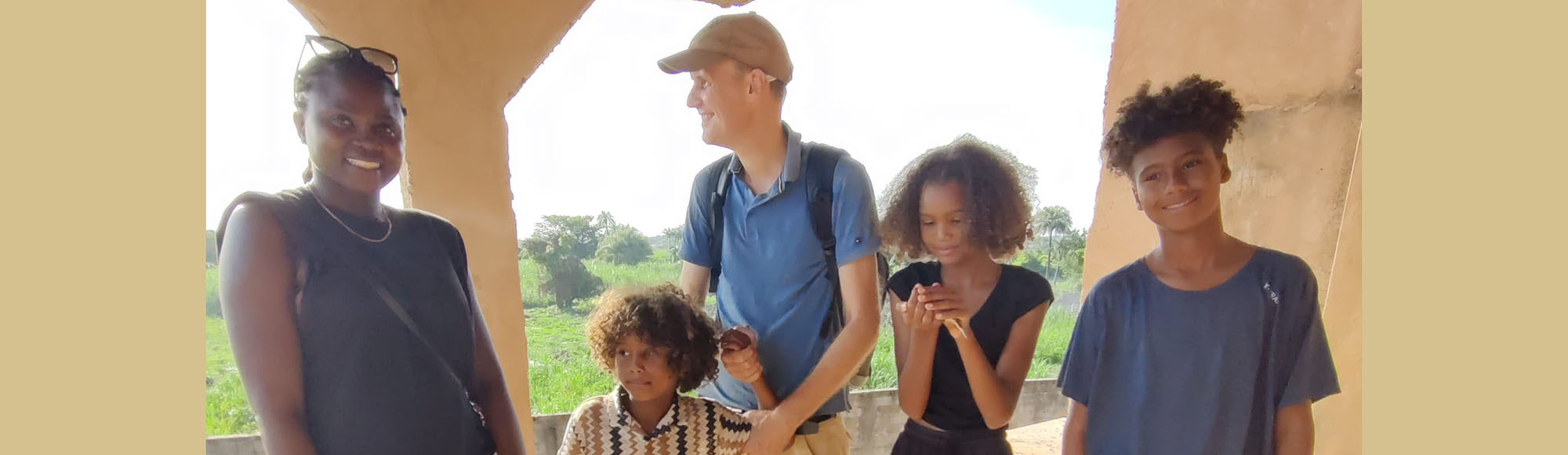
How to! Take your school-age children with you on a research stay abroad
Morten Bjerregaard-Andersen has lived abroad several times as part of his research career. It has brought significant professional and personal rewards – and having three school-age children is no barrier to making it work.
– Just go for it.
That is how Morten Bjerregaard-Andersen sums it up. He is a medical doctor and a researcher in diabetes. His first research stay abroad was during his medical degree, and it was also during a stay abroad that he met his wife.
Most recently, he, his wife and their three school-age children spent four months in Guinea-Bissau. In this edition of How to, you can find out more about how it is possible to go abroad with school-age children.
– Guinea-Bissau was the obvious choice for us as a family. I have research collaborations and projects there, my wife is from there, and we have visited before, Morten explains.
– That also made the practical arrangements easier, as we already knew the place.
One of Morten Bjerregaard-Andersen’s key recommendations when it comes to a research stay abroad is to get to know the place in advance. If possible, visit the research centre and the city so that you have seen it with your own eyes.
Three top tips
Morten Bjerregaard-Andersen’s three top tips for a research stay abroad with the whole family
- Plan well in advance. It takes time to save up, apply for funding and deal with practical matters such as schooling and accommodation. It takes up a great deal of time in the period leading up to departure, so do not spend more than a year on the practical preparations – otherwise you risk putting too much on hold at home.
- Save up. It is simply more expensive to be abroad than to stay at home. Some expenses at home will also continue during your stay.
- Get a car! This is almost my most important piece of advice. Without a car, you are very restricted, especially as a family with children. Whether you rent or buy is a matter of preference, but having a car makes everyday logistics much easier – and it opens up opportunities for weekend adventures and excursions.
– We previously spent three and a half months in Portugal as a family. I visited beforehand to explore the setting – and I would definitely recommend doing that if you can.
Schooling abroad – this is what we did
Morten Bjerregaard-Andersen has three children aged 6, 9 and 12. Their four months in Guinea-Bissau therefore also involved attending an international school. In Denmark, education is compulsory, but attendance at a particular school is not. In principle, this meant that Morten and his wife could have chosen to home-school their children during their stay abroad.
– We decided that the children should attend an international school. That made the most sense for us in terms of being able to do our jobs, but also to ensure that the children gained as much as possible from the experience, Morten explains.
– We had heard about the international school in Guinea-Bissau from others. In Portugal, however, we visited the school beforehand – and I would clearly recommend doing that if possible.
At the international school, there were children from all over the world. In addition to their academic work, the children were introduced to other cultures and met people from different backgrounds.
Four months is long enough to establish a sense of everyday life as a family: getting up and going to school and work, taking part in leisure activities and all the other routines that make up daily life. At the same time, it is not so long that the children cannot relatively easily return to their school and friends back home in Denmark.
More than research: everyday life and experiences
However, a research stay abroad is not only about work and school. A longer stay offers much more. It provides the opportunity to pause and enjoy being away.
– We know Guinea-Bissau well, and there are many people we want to see when we are there. This time, because we stayed a bit longer, we had the opportunity to do that, says Morten Bjerregaard-Andersen.
– It gave us the freedom to slow down and enjoy the moment, to sit on the terrace and simply enjoy being there.
Morten Bjerregaard-Andersen also encourages researchers to involve their partner in the entire process before going abroad.
– It has to be an acceptable everyday life for your partner. It has to feel meaningful. They may also be putting their career on hold for a period, Morten explains.
– My wife did not have a job she could bring with her, but she did voluntary work and became involved in a school project here in Guinea-Bissau. When we were in Portugal, she took annual leave and, among other things, spent time visiting family in the country.
Planning, finances and practical advice
On a practical level, Morten Bjerregaard-Andersen recommends planning your research stay abroad well in advance. There are many practical matters to consider, including schooling, accommodation and finances.
– You need to save up. I applied for funding for my stay, but we covered the family’s expenses ourselves. And you have to remember that for a period of time there will only be one income, Morten explains.
Collaboration and funding
The stay took place in collaboration with the Bandim Health Project and the Guinean Diabetes Association (ANDD).
It was supported by the Internationalisation Fund at Esbjerg Hospital.
In terms of the practical arrangements, Morten recommends involving the host research institution. They can often help with practical matters or direct you to the right contacts.
– And make sure you have a formal agreement in place. It should not be just one professor who knows you are coming – the entire research institution needs to be prepared. Also check that it is actually possible to carry out what you have planned, Morten says.
– And remember that there is an everyday working life at the research institution – and you need to be part of it. Be flexible and approachable, and get a sense of how things are done: How do you do things here?
And as Morten Bjerregaard-Andersen himself says:
– Just go for it.
Meet the researcher
Morten Bjerregaard-Andersen is a medical doctor and a researcher in diabetes. He is a clinical associate professor at Department of Regional Health Research and Esbjerg & Grindsted Hospital, the Research Unit of Endocrinology in Esbjerg, and at the Centre for Global Health at the Department of Clinical Research. He is part of a large Danish study on COVID-19 and the development of type 1 diabetes. In addition, he collaborates with the Bandim Health Project and the Guinean National Diabetes Association (ANDD) in Guinea-Bissau on diabetes research. Morten Bjerregaard-Andersen’s research time is supported by the Departments of Endocrinology and Nephrology at Esbjerg Hospital, the Department of Regional Health Research and Steno Diabetes Center Odense.
Learn more:
- How to! Bring your family on a research stay abroad
- How to! Build an International Network with a Research Exchange
- How To! Forming an International Team in a Clinical Setting
- Sådan! Giv din første mundtlige præsentation på en international kongres
- How to Involve Users in Research
- Sådan! Udvid dit faglige netværk med et udlandsophold.