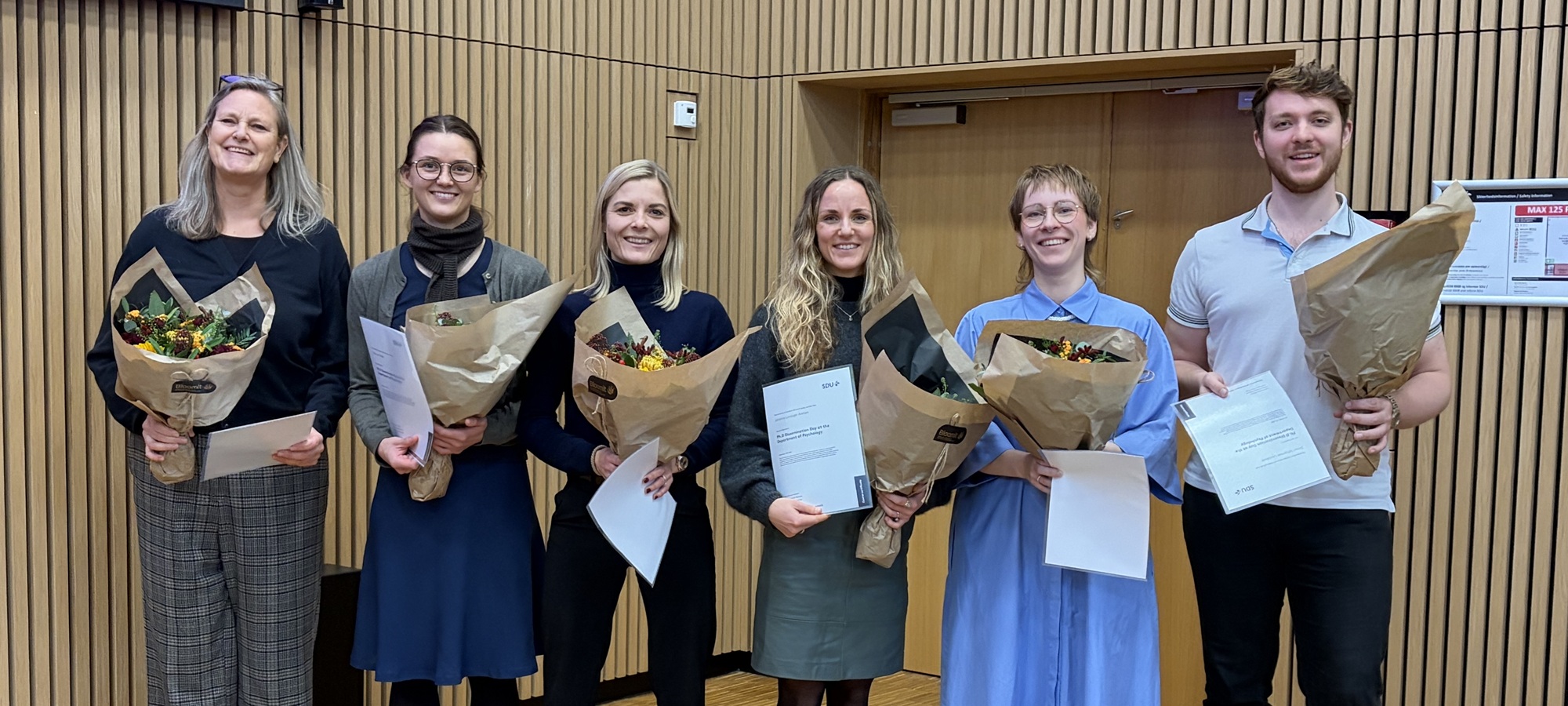
Six courageous PhD students put their research communication skills to the test
Hvordan forklarer man sin forskning, så alle kan forstå den? Det fik seks ph.d.-studerende fra Institut for Psykologi mulighed for at prøve kræfter med, da instituttet for første gang afholdt sin egen ph.d.-cup.
Standing in front of an audience and presenting several years of research in just a few minutes takes both courage and the ability to see the bigger picture. Especially when the audience includes people who may not be familiar with your field of research.
But that was precisely the challenge facing six PhD students from the Department of Psychology when they took part in PhD Dissemination Day.
Fittingly, the event took place in a room called Dialogen (The Dialogue). After all, the aim was to make research understandable, relevant and interesting to others.
Three key areas of focus
The six participants presented their research projects to a panel of judges, who then provided feedback on their communication skills.
The panel focused on three key questions:
- Was the presentation clear, engaging and easy to follow?
- Was it clear why the research matters?
- Did the participants manage to explain the key points of their research in a way that people outside their field could understand?
In other words, the participants were assessed not only on the scientific quality of their research, but also on their ability to communicate it.
The judging panel consisted of Assistant Professor Riikka Pauliina Svane, Associate Professor Julie Christiansen and Professor Tonny Elmose Andersen from the Department of Psychology, along with Head of Section Sigurd A. Kristoffersen from SUND Communication.
Six winners and plenty of excellent research communication
The six participants were Amanda Ryssel Hovmann, Simon Schjermer Lauridsen, Lotte Dich Kring, Johanne Lundager Axelsen, Frida Lau Græbe and Sussanne Hangård Vendelbo.
Although the event was inspired by the competitive format of the PhD Cup, there was no single winner.
All six delivered impressive presentations, demonstrating that even complex research can be made engaging and accessible. The day therefore ended with flowers and certificates for all six participants.
Because when it comes to making research accessible to more people, everyone who has the courage to stand up and share their work deserves recognition.
Three tips for communicating research effectively:
1. Avoid too much text
The more text you put on your slides, the harder it becomes for your audience to listen to you at the same time. The brain struggles to read and listen to different messages simultaneously. So keep the words on your slides to a minimum and let your spoken presentation take centre stage. Also consider how you might use body language or a physical object to help bring your story to life.
2. Be bold – and leave things out
Good communication is also about what you choose to leave out. Do you really need to include every reference and methodological detail? Think about what your audience needs to understand your message. Anything else can be left out or given less attention.
3. Choose your key message carefully
How many points do you want your audience to remember? If time is limited, focus on just a few – perhaps even a single key message. Make your main point clear from the outset, and don't be afraid to repeat it throughout your presentation. Consider using a specific case or a visual example that your audience can relate to.
Source: SUND Communication