EPICUR
SDU to lead EPICUR’s work on the skills of the future
On 1 November, a new two-year project period begins for the European university alliance EPICUR. Several of the alliance’s joint initiatives are to be integrated into the universities’ standard practices, and SDU will be responsible for work on the skills of the future.
After six years of collaboration, EPICUR has developed and tested joint teaching programmes, new forms of mobility and a shared digital infrastructure. Through the EPICUR-SHAPE-IT-PLUS project, several of these solutions are to be integrated into the universities’ study programmes and workflows.
Among other things, the partners aim to make it easier for students to incorporate study periods and modules at partner universities into their degree programmes and to receive credits for them. At the same time, the digital infrastructure will be further developed so that it provides even better support for course enrolment, mobility and credit transfer.
– The universities in EPICUR have developed joint courses and trialled new teaching programmes. Now we need to make it easier for more people to use them. This requires both the academic frameworks and the administrative procedures to function seamlessly across universities, so that a course or a teaching collaboration through EPICUR becomes a natural part of everyday life, says Ida Thøstesen, International Relations in the Rector’s Office at SDU.
Skills for students, lecturers and researchers
SDU will lead the work on Future Skills, which encompasses digital and green skills, entrepreneurship, research skills and active citizenship.
The programmes are aimed at students, lecturers, early-career researchers and participants in further and continuing education. Among other things, teaching staff will be able to enhance their skills in the responsible use of artificial intelligence in teaching and in organising international, virtual and hybrid teaching programmes. For early-career researchers, the plans include programmes on research methods, scientific publishing and public engagement in research.
SDU will also lead the work to lay the foundations for a shared online entrepreneurial environment for students. The partners will develop and trial teaching in entrepreneurship, innovation programmes and mentoring schemes across the universities.
– As the lead institution for the Future Skills initiative, SDU will have the opportunity to shape how we in the alliance approach skills development across education, research and further and continuing education. We can draw on the expertise of our own academic departments and develop programmes in collaboration with colleagues from the partner universities. For staff, this is an opportunity both to develop their professional practice and to engage in new academic collaborations, emphasises Ida Thøstesen.
Three new universities join the alliance
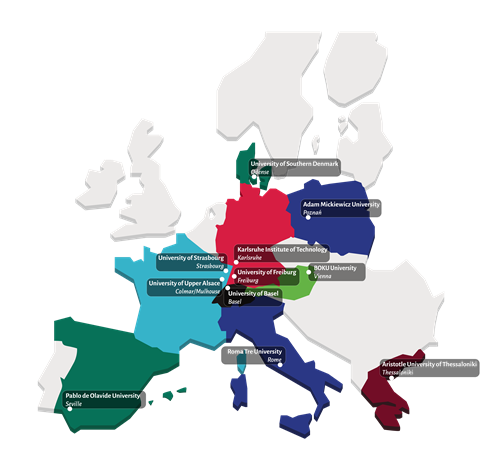
Pablo de Olavide University in Seville and Roma Tre University in Rome are joining as full partners, whilst the University of Basel is participating as an associate partner. These partners will contribute a strong regional presence in Southern Europe and strengthen EPICUR’s capacity for innovation. The University of Amsterdam is leaving the alliance.
EPICUR now comprises 11 universities in nine countries, with around 280,000 students, 29,000 academic staff and 17,000 administrative staff.
EPICUR-SHAPE-IT-PLUS has received €7.2 million from Erasmus+ and will run until 31 October 2028. SDU’s share of the EU grant is just over €961,000.
On 18–19 November, the partner universities will meet at Adam Mickiewicz University in Poznań for the kick-off of the new project period.