Vejleder: Changzhu Wu
Medvejleder: Vasco Figueiredo Batista
Projektbeskrivelse
Biocatalysis offers a promising path for sustainable chemical synthesis. By using enzymes or whole cells, we can replace traditional chemical catalysts that often require harsh conditions and generate toxic waste. However, challenges remain: biocatalysts can be unstable, and their reactions are limited to those found in nature.
The Wu group has worked to improve biocatalyst performance by using biocompatible chemistry to modify the surface of proteins and bacterial cells.[1] These approaches have increased their stability and even enabled new catalytic activities. Still, we are always looking for better ways to introduce reactive groups in a sustainable manner.
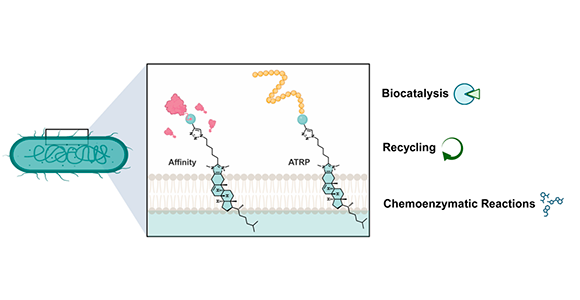
Recently, we have focused on artificial lipids as tools for cell membrane modification. These molecules can integrate into the membrane of Escherichia coli, altering its properties and providing anchor points for further chemical reactions.[2] This project will build on these advances, exploring affinity, host–guest, and covalent interactions to connect bacteria with chemical catalysts and polymers.
The project will consist of the following tasks:
- Expression, modification, and characterization of E. coli cells bearing artificial lipids
Training in cell expression and heterologous enzyme production in E. coli. The student will also apply microscopy techniques, particularly confocal microscopy, to visualize the modified cells. - Design and characterization of biocompatible, anchorable catalysts for cell modification
Depending on the student’s interest, the project may include a synthetic chemistry component to design catalysts that attach to the cell surface. This will involve organic synthesis, purification, and characterization (NMR, IR, UV-Vis, MS). - Evaluation of the catalytic performance of modified E. coli cells
The final stage will assess the catalytic activity of the modified cells using chromatographic techniques such as GC and HPLC.
Reference
[1] J. Ning, et al., C. Wu. Nat. Catal. 2024, 7, 1404-1416.
[2] T. Wegner, et al., J. Jose. Chem. Sci. 2023, 14, 11896-11906.