Vejleder: Changzhu Wu
Projektbeskrivelse
Bacteria, as hardworking prokaryotic cells with intricate enzymatic machinery, can catalyze multi-step reactions, making them ideal for many industrial bioprocesses. However, their adaptability under industrial conditions is limited. Industrial environments often fluctuate in temperature, pH, and substrate concentrations. Traditional whole-cell systems are not designed to handle such dynamic changes, which severely restricts their effectiveness in demanding industrial processes.[1]
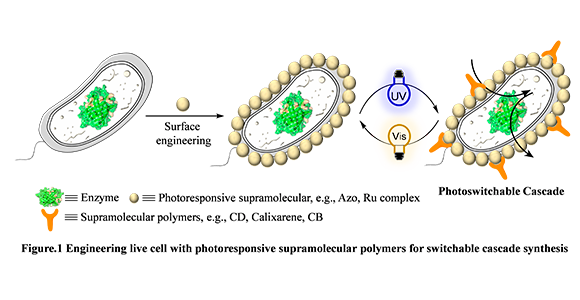
To address this challenge, we aim to develop a new chemical method to engineer bacteria for dynamic regulation of whole-cell catalysis in response to changing conditions. Our approach also seeks to enable efficient catalyst recycling without loss of activity. Specifically, we plan to use a surface-coating strategy, modifying bacterial surfaces with functional supramolecular polymers to confer new-to-nature catalytic functions (such as novel catalytic cascades and stimuli-responsive behavior).
In this project, Escherichia coli will be used as the model organism. Diverse supramolecular polymers will be chemically attached to the surface of E. coli using biocompatible methods, generating “supramolecular bacteria” (SupraBacteria). We expect these SupraBacteria to respond reversibly to external triggers, allowing dynamic regulation of their catalytic activity as environmental conditions change.
We have previously demonstrated that supramolecular polymers can successfully modify free enzymes for recyclable biocatalysis. We have also shown the feasibility of coating E. coli with a classical host–guest polymer (e.g., a, β-cyclodextrin-based polymer) to engineer the cell surface for recyclable biocatalytic cascades.[2] These prior successes lay a strong foundation for the current project. We anticipate that a supramolecular tunable and stimuli-responsive whole-cell catalyst with novel functionalities will be well-suited to meet the challenges of industrial biocatalysis.
This work will involve multiple interdisciplinary steps: supramolecular polymer synthesis; bacterial cell culture and activity assays; live-cell surface modification and characterization (using confocal and electron microscopy); and catalytic performance testing.
Reference
[1] L. Guo, W. Diao, C. Gao, G. Hu, Q. Ding, C. Ye, X. Chen, J. Liu, L. Liu, Nat. Catal. 2020,3, 307-318; R. A. Sheldon, J. M. Woodley, Chem. Rev. 2018, 118, 801-838.
[2] S. Wang, R. Hübner, H. Karring, V. F. Batista, C. Wu, Angew. Chem., Int. Ed. 2024, e202416556; S. Wang, L. Chen, C. Wu, Colloids Surf., A 2023, 672, 131719.