Vejleder: James McPherson
Forudsætninger: KE505 og KE525 skal være bestået.
Projektbeskrivelse
Catalysts are the cornerstones of modern industry, and so society’s transition to more sustainable processes begins with the discovery and development of new catalysts. Organometallic chemists create new molecular catalysts with exquisite control of their atomic and electronic structures. These are ideal systems to study and design catalysts for new processes to replace today’s reliance on fossil reserves of oil and natural gas, for example by reversibly transforming water into hydrogen (and oxygen) gas.
The two main features that make these molecular catalysts so attractive to study in the laboratory have thus far held them back from widescale use in industry. Just as any customised product tends to be more expensive than mass produced, off-the-shelf alternatives, so too are molecular catalysts far too expensive except in niche cases where there are no existing alternatives. This is further exacerbated by difficulties faced by separating and recovering these expensive catalysts from industrial reactors at the end of each reaction batch.
My group develops metal–organic frameworks (MOFs), in which molecular organometallic complexes are tied together by organic linkers to construct crystalline, polymeric materials. These MOF catalysts are robust solid materials, so are far more easily recovered and recycled after each reaction than molecular organometallic complexes.
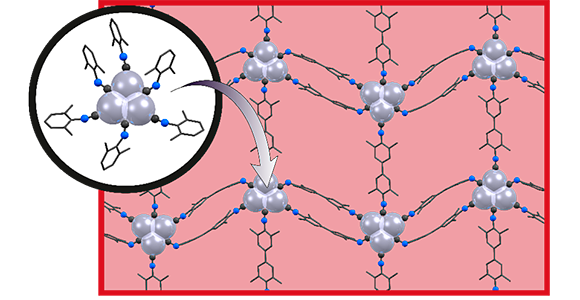
Projects in my group involve a mix of synthetic organic and inorganic chemistry: You will make organic ligands and linkers (typically bearing isonitrile groups (RNC:) to bind and stabilise low-valent metal centres). You will then construct a molecular organometallic complex which you will characterize using a battery of analytical techniques: e.g., NMR, UV-vis-absorption, and FT-IR spectroscopies, Single Crystal and Powder Diffraction, Thermogravimetric Analysis and Cyclic Voltammetry. Finally, these molecular building blocks (the organometallic complex and isonitrile linkers) will be combined to assemble new metal–organic frameworks, and we will later test whether these frameworks retain the properties of the molecular complexes.