Growth
NAT drives strong growth in external research funding
NAT has in recent years established itself as a key driver of SDU’s overall growth in external research funding. New figures show strong and stable growth in external funds from 2020 to 2025.
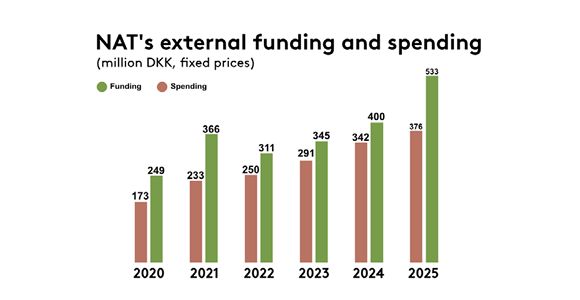
Developments at NAT reflect a faculty with a high level of activity and a strong capacity to attract external research funding. Throughout the period from 2020 to 2025, income has consistently exceeded expenditure, indicating a sound financial balance and continued potential for research activities and investments.
In 2020, NAT secured DKK 249 million in external funding. Already the following year, this rose significantly to DKK 366 million, and by 2025 the figure reached a record high of DKK 533 million. This is shown in the latest report from SDU RIO.
– External funding contributes to increased research activity at NAT, and it is simply very gratifying to follow the many different projects and new results that are continuously presented in various contexts, says Dean Marianne Holmer.
– However, the increased activity also means that offices are becoming crowded and we are working side by side in the laboratories. The physical facilities are struggling to keep up, but solutions are on the way with additional space, she adds.
Broad funding base with rising private and international contributions
A closer breakdown of external funding shows that NAT has a broad and diverse funding base—and that its composition has evolved considerably over the period.
Danish private sources constitute the largest and clearly growing funding source. Funding from private actors increases from DKK 107 million in 2020 to DKK 300 million in 2025.
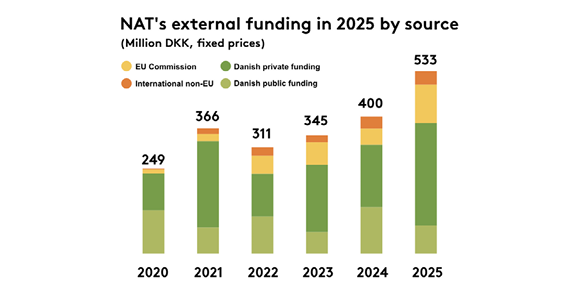
EU funding is also playing an increasingly important role. Funding from the European Commission has risen from DKK 13 million in 2020 to DKK 112 million in 2025.
– Unfortunately, several other universities are far more successful in securing EU funding, and we will be working strategically to obtain more funding, particularly from Pillar II of the new framework programme, says Marianne Holmer.
Danish public funding presents a more fluctuating pattern. Funding levels vary over the period and stand at DKK 82 million in 2025, which is lower than in 2020, when the level was DKK 127 million. This decline can particularly be explained by lower success rates with DFF.
Finally, non-EU international funding has also increased, albeit from a lower base. Funding rises from DKK 2 million in 2020 to DKK 39 million in 2025.
– It is difficult to assess how international collaboration will develop in light of the unstable geopolitical situation. I consider it important that NAT continues to work internationally, as our research is global, and collaboration with international colleagues is often highly inspiring. Several studies also show that it increases the quality of research, which is cited more frequently than purely national publications, says Marianne Holmer.
Overall, the distribution shows that NAT is increasingly attracting funding from private and international sources, which both spreads risk and strengthens the faculty’s global research collaborations.
NAT accounts for the largest share of SDU’s funding
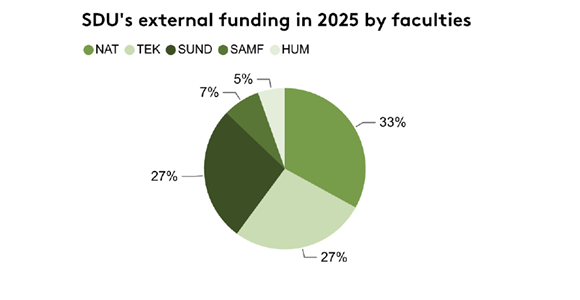
NAT’s strong development is also reflected in its prominent position across SDU. In 2025, the faculty accounts for 33 per cent of the university’s total external funding. NAT is thus the largest contributor of external funding among the faculties.
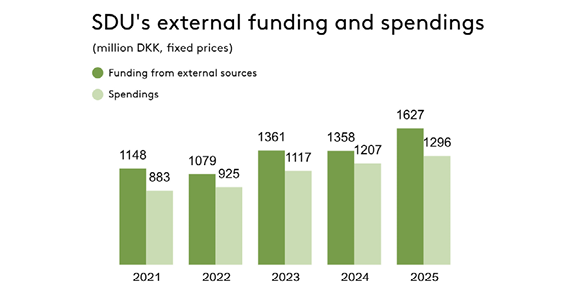
The development at NAT should be seen in the context of a generally positive trend at SDU. SDU’s total external funding increases from DKK 1,148 million in 2021 to DKK 1,627 million in 2025, while expenditure grows from DKK 883 million to DKK 1,296 million over the same period.
A strong position with an eye to the future
The development demonstrates that NAT is a faculty in solid progress.
It creates a robust foundation for future research initiatives while strengthening SDU’s overall position as a research institution—both nationally and internationally.
– We are living in uncertain times, but to me it is even clearer that there is a need for more research. New ideas and new knowledge are required to address the many global challenges. I do not expect NAT to maintain the same level of growth as in recent years, but it would be positive if we can maintain the current level and preferably achieve continued moderate growth, says Marianne Holmer.