My Competence Portfolio
My Competence Portfolio is a joint initiative at the Faculty of Science, where we work on integrating reflection into teaching. The aim is to make students more aware of what they are learning and how they can apply their skills further.
When students are given the opportunity to pause and reflect, they become better at understanding:
- what they have learned (competencies).
- what they have improved at (progression).
- how it can be applied further (transfer).
This strengthens both their learning, engagement, and confidence in their own abilities.
For you as a lecturer, this means that with a few simple steps, you can help your students get more out of your course – without requiring much extra time. On this page, you will find specific activities and inspiration from other lecturers that you can use directly in your teaching – whether you teach theory, exercises, or practice.
My Competence Portfolio is supported by the Novo Nordisk Foundation and is based on research into how reflection can enhance students’ learning and competence awareness. The goal is simple: to make reflection a natural part of teaching – in a way that works in practice.
”
It was nice to pause and actually reflect on my learning.
– student at the Faculty of Science
”
I gained a better overview of what I actually gained from the course.
– student at the Faculty of Science
”
Competence awareness is one of the cornerstones of the faculty’s educational strategy, as it is crucial for students to translate their knowledge from studies into the real world.
– Vice Dean Poul Nielsen
-
How do I get started?
-
How do we measure the project?

Get inspiration from other teachers
Here you will find concrete and easy-to-read examples from teachers across the Faculty of Science who have worked with reflection in their courses – for example, in lectures, exercises and laboratory teaching. All cases are based on a specific challenge and show what the teacher has done – and what the outcome was.
You can use cases as inspiration for your own course – or contact the teacher directly if you want to learn more. Your course can also be tailored with support from consultants at SDU RIO. You will receive a concrete proposal tailored to your course and ready to use.
Teacher
Natasha Marie Hansen, aeaching assistant
Problem
Students struggle with the transition from high school to university and lack insight into study techniques.
Initiatives
- Encouraging ongoing reflection on learning – 10 minutes allocated in each session.
- Reflection assignment as an exam focusing on the transition from high school to university, reflections from the course teaching, and a look towards the future.
- Students were assessed on their ability to reflect on their outcomes and efforts in the course.
Outcome
Most students ended up looking back positively on the course, which helped many settle into their new role as students. The instructors were also very positively surprised by the students' approach and see it as a good way to get a sense of the students.
It provides insight into how the 1st semester has functioned, what has gone well, and what has not gone so well. Which students are thriving, and which students are considering dropping out and why.
Teacher
Adelina Rogowska-Wrzesinska, associate professor
Problem
Students memorize the material but do not understand it.
Initiatives
- Lectures were replaced with self-study sessions – students, in small groups, compared two biochemical processes by creating a diagram.
- Students provided feedback to each other and received feedback from peers and an instructor.
- Students wrote a short reflection in their groups.
Outcome
Students demonstrated increased conceptual and cohesive understanding. They transitioned from rote memorization to understanding mechanisms. Students made active choices about relevance and simplifications. Peer feedback and group work strengthened understanding, though engagement varied.
Teacher
Janne Kudsk Klitgaard, associate professor
Problem
The students are accustomed to working with subject-specific knowledge and concrete tools, and here they encounter for the first time the creative mindset, where work is conducted openly and innovatively without one correct solution.
Initiatives
- The students were introduced to innovation and innovation processes through teaching and presentations from SDU RIO about innovation, creativity, and the role of different competencies in innovation work.
- The students worked on developing ideas and relating their academic knowledge to possible applications, products, or further studies.
- In the project work, the students were required to write an innovation section where they described their innovation process, reflections, and arguments for their ideas.
- The students engaged in creative problem-solving and discussions of various solution possibilities in groups.
Outcome
The initiatives contributed to the students increasingly viewing their academic knowledge in an application-oriented and innovative context. Several students became more aware that scientific work also involves creativity, idea development, and reflection on how new knowledge can be translated into value or practice.
Teacher
Nadia Skarnager Andersen, teaching assistant professor
Issue
Students struggle with the transition from high school to university and lack insight into study techniques.
Initiatives
- At the beginning of the semester, students interview each other about learning techniques, the transition from high school student to university student, and their role as students, then set personal goals.
- At the end of the semester, they evaluate their goals from part 1 and reflect on whether they have been achieved and how they will continue to work on them. The response is included in a mandatory submission.
Outcome
The study introduction has yielded predominantly positive outcomes and increased students' awareness of study habits and learning strategies. The effect is particularly evident in reflection and inspiration, while changes in concrete behaviour are more limited. The outcome is clearly strengthened by follow-up but hindered by varying levels of engagement and unclear objectives.
Key improvements: Clearer objectives, better instructions, and consistent follow-up.
Instructor
Michael Petersen, associate professor
Issue
Problem-solving, collaboration, handling frustration.
Initiatives
- Academic reflection was introduced as a learning tool.
- Written reflection was made mandatory in the last three reports.
- Students received clear guidance on the purpose and expectations of reflection.
- Reflections were not graded but supported with brief feedback.
Outcome
Most students took the tasks seriously and were honest in their reflections. The reflections helped the instructor provide more targeted academic feedback to the students. The instructor observed that several students clearly benefited from setting goals, which they fully or partially achieved, and from reflecting on their general scientific competencies and how these can be applied throughout their educational journey.
Instructor
Christina Wegeberg, assistant professor
Problem
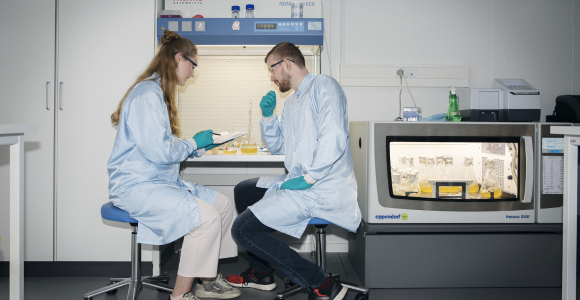
The transition from theoretical knowledge to practical application in the laboratory.
Initiatives
- Incorporation of reflection questions in reports: What went well? Which theory was applied? What could be improved next time? How did it go compared to last time? Did you achieve your goals from last time?
- Presentations with peer feedback groups.
Outcome
The initiative has enhanced students' understanding of the connection between theory and practice in the laboratory, where they actively applied theoretical concepts. The structured framework and collaboration contributed to clarity, confidence, and better problem-solving. However, there were challenges with instrument handling, technique, and logistics.
Teacher
Eva Bang Harvald, teaching associate professor
Issue
Students lack self-awareness regarding their personal roles in professional group dynamics and struggle to communicate effectively during group work.
Initiatives
- Work on a company case in groups and hold meetings with the company.
- Students set both personal general learning goals and learning goals for group work.
- Reflection report on group work, personal learning, and skill development.
Outcome
The project has overall met the learning objectives by enhancing students' collaboration, independence, and ability to work on real-world challenges. Feedback particularly highlights an improvement in their group work skills and an increased understanding of the importance of effective communication.
Try it in your course – no extra preparation needed
Here you will find simple activities and materials that you can use directly if you want to work with reflection in your course.
For example, you can use the short reflection cards or try out the Plug & Play activities.
Everything is designed so you can get started quickly – without changing your teaching or spending much time on preparation.
Who can help me?
If you have questions or need guidance regarding the implementation of My Competence Portfolio in your teaching, you can contact one of the following people:
Linette Sønderby
Email: linette@sdu.dk
Email: linette@sdu.dk
Johanne Rabjerg Hansen
Email: jorah@sdu.dk
Helene Fast Seefeldt
Email: hefs@sdu.dk
Department of Biology
Sara Egemose
Email: saege@sdu.dk
Department of Biochemistry and Molecular Biology
Karin Hjernø
Email: hjernoe@bmb.sdu.dk
Department of Physics, Chemistry and Pharmacy
- Physics: Maria Bloksgaard, mbloksgaard@sdu.dk and Sofie Marie Koksbang, koksbang@cp3.sdu.dk
- Chemistry: Michael Petersen, mip@sdu.dk
- Pharmacy: Nadia Skarnager Andersen, ngb@sdu.dk
Department of Mathematics and Computer Science
Benjamin Jäger
Email: jaeger@imada.sdu.dk