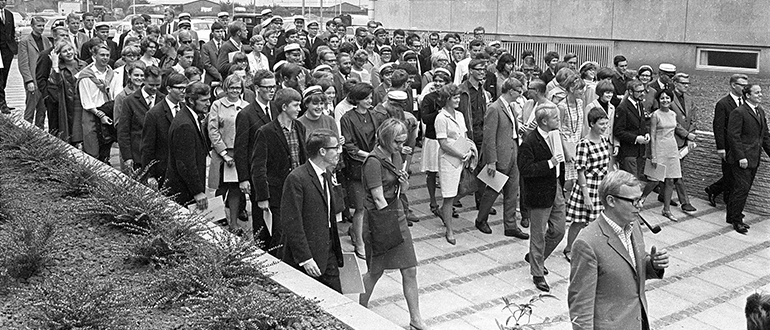
An education-focused university in constant motion for 60 years
The University of Southern Denmark celebrates its 60th anniversary this year. To mark the occasion, throughout 2026 a series of articles will highlight key themes that trace back to 1966 and continue to define the University today. This article focuses on education – and on how pioneering spirit, student influence and new degree programmes have shaped SDU from its first 180 students to becoming a regional and international university with more than 200 times as many students.
On 31 August 1966, Odense University first opened its doors in temporary facilities at Odense Technical College. 180 students entered a university that was, in practice, being built while it was being used – first in borrowed premises, later in barracks, and from the mid-1970s on Campusvej.
Today, the picture is very different. SDU is a multi-campus university with five faculties, a strong regional presence and a high-quality study and research environment, in which internationalisation is part of the everyday life of around 20,000 students.
Teaching was reimagined from the outset
The University’s early years have often been described as a teaching laboratory: new ways of teaching, evaluating and examining, and a study environment created through the joint efforts of academic staff and students.
During the 1970s, student influence became a concrete and defining element of the University’s history rather than merely an idea.
One of the most striking symbols of this is ‘the golden crowbar’ – a relic of the student activism of the 1970s, it was intended to ‘break down the walls’ and insist on openness to society and influence for students: Read the story of the golden crowbar
Greater demands on students and a more regional university
During the 1980s and 1990s, the University evolved into more than just ‘Odense’. It developed into a university that was rooted across the entire region, a trajectory that is still continuing today: SDU now covers all of the Region of Southern Denmark – including the upcoming campus in Vejle.As the higher education sector faced increasing demands for documentation, quality and efficiency, the framework for teaching changed. Students were expected to navigate more flexibly and take greater responsibility for their own learning. In 1998, Odense University became the University of Southern Denmark through a series of mergers, which significantly expanded SDU’s educational landscape.
An international classroom: from Erasmus to EPICUR
Internationalisation has been an integral part of the history of the University’s education programmes for decades. SDU’s own historical accounts indicate that internationalization really took off with the ERASMUS programme in 1987. And from 2017 onwards, it was the ambition that all students should have the opportunity to include an international dimension in their education through a stay abroad.
In recent years, mobility has taken new forms. Through the EPICUR alliance, students can, for example, take international courses online, which allows them to build international experience into their studies in more ways than through the traditional exchange semester. The international dimension is also evident in teaching and research environments, in which international colleagues and fellow students are increasingly becoming part of university life at SDU.
Throughout its history, SDU’s educational profile and programme portfolio have developed and adapted to the needs of society – from the medical programme at the founding of the University to the new IT and STEM programmes in Vejle, which will open next semester.
The University of Southern Denmark’s 60th anniversary
To mark the anniversary, a series of articles with a historical perspective will highlight defining characteristics of the University that has developed over 60 years – from its first facilities in Odense to a multi-campus university with regional and international impact.
