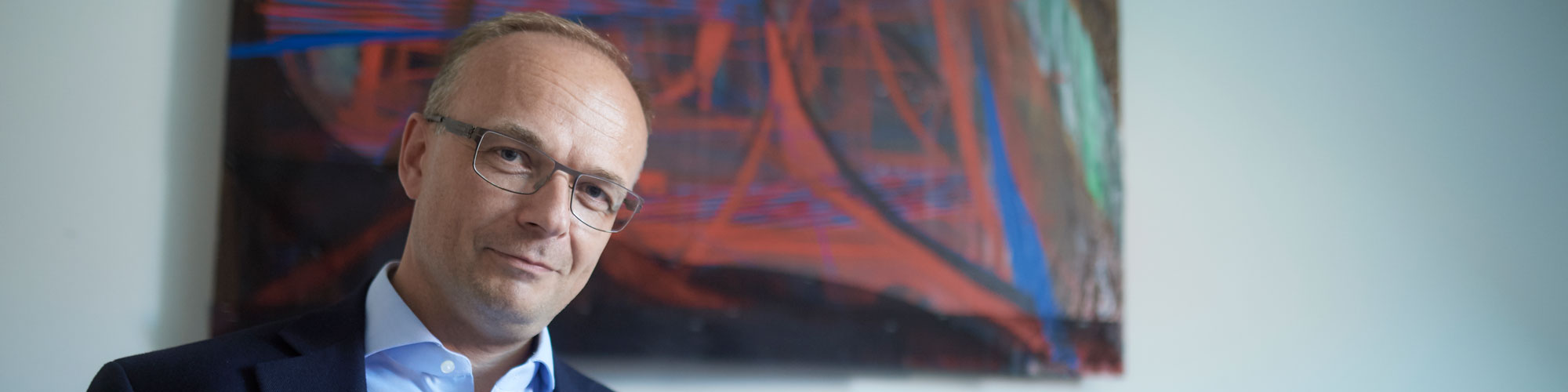
Breakthroughs do not happen automatically – it takes people to make them happen
Recently, Aleksander Krag, SDU professor and senior consultant at OUH, received the prestigious Hagedorn Prize for his important scientific work for patients with chronic liver disease. We sat down with him to talk about making research breakthroughs that make a difference to people.
Aleksander Krag had a clear vision when he joined the University of Southern Denmark and OUH as a professor of liver diseases in 2013.
He wanted his research to have a noticeable impact on the patients he met in the outpatient clinic.
The time had come to change the all-too-familiar story of the liver patient – let us call him Henry – who only goes to the doctor once the symptoms are severe and nothing can be done.
- Patients like Henry are the reason our research group exists: our research must be relevant to the patients. They come to us asking three questions: Am I ill? Is it dangerous? And can you treat it? We needed to find better answers to the questions our liver patients were asking, Aleksander Krag says of his vision.
Every year, approximately 1,000 people in Denmark die of liver cirrhosis. However, liver diseases develop slowly and largely without symptoms for 20–30 years before patients end up with cirrhosis. Approx. 25 per cent of the Danish population have too much fat in their livers, and up to 150,000 have scar tissue on their livers.
Breakthroughs do not happen automatically
The task has therefore always been clear to Aleksander Krag.
- The 20-year window during which the disease develops must be utilised. We want to identify people with liver disease 20 years earlier so that they can receive treatment and live 20 years longer.
Of course, this is easier said than done. Or, as Aleksander Krag himself puts it:
- Scientific breakthroughs do not happen automatically. It takes curiosity, ambition, patience and, not least, the ability to gather good and talented people around you.
Based on these guidelines, Aleksander Krag and his research group have achieved groundbreaking and innovative results over the past decade. Today, the group’s advanced methods make it possible to systematically monitor the development of patients with chronic liver disease and adjust their treatment before the disease gets out of control.
Research and innovation intertwined
And the methods are already being used in practice in various ways.
In the form of both corporate partnerships and the spin-out company Evido, which has developed software that can detect liver disease based on routine blood samples.
- It has always been clear to me that if we really wanted to make a difference for Henry and the many other liver patients, we would have to deliver high-quality research that could be combined with innovative technologies that work in the real world.
Aleksander Krag and his research group are now seeing the effects of combining groundbreaking research and innovative technologies from the outset on a number of levels.
The group’s solid data, based on studies of 9,000 patients, more than 1,000 liver biopsies and a biobank with 300,000 samples, combined with in-depth knowledge of the development of liver diseases, makes them an important partner for pharmaceutical companies developing drugs to treat liver diseases.
The voice people trust
At the same time, Aleksander Krag is in the process of writing review articles on liver diseases for JAMA and The Lancet, two of the world’s most renowned medical journals.
- I am truly honoured that our research group has become the voice that people trust. In the coming years, the knowledge and the methods we have built in the field of liver diseases will become the standard that doctors and lecturers around the world rely on, says Aleksander Krag.
He is also pleased that the policy efforts regarding recognition and higher prioritisation of liver disease treatment, which he initiated as president of the European Association for the Study of the Liver (EASL), are now on the agendas of both the UN and the WHO.
But how did he manage to successfully advance a research area both on the international scientific scene and in practical patient care?
To answer this question, Aleksander Krag returns to where we started. To him, the recipe has always been curiosity, ambition, patience and, not least, the ability to gather good and talented people around you.
Humble and grateful
But he specifically emphasises that it is all about people.
- I am humble and deeply grateful for the opportunities and privileges I have been given – ever since I was a young medical professor – by my managers, by organisations and by foundations. I have received exceptional encouragement to work ambitiously and with a long-term perspective, he says and elaborates:
- And I would like to add that none of this would have been possible without all the patients and citizens who participated in our studies and agreed to share their samples. And, last but not least, our advisory board of patients, with whom we have calibrated our research ideas and knowledge for many years.
At the same time, he is convinced that the very special approach in his research group is the secret behind their success.
- Personally, I like to feel that I’m thriving. This is why, from the outset, my focus has been on creating an environment in which people thrive and are passionate about working together. This is how people are most innovative and how they get the best basis for developing their talents, he says and elaborates:
- For us, there is no conflict between academia and family life. People who have been bitten by the academic bug are incredibly self-motivating, so I focus more on getting people in the research group to take a break than getting them to work hard. And I have no doubt that the synergy in our group is an important reason why we have been able to achieve international breakthroughs in liver research.
About Aleksander Krag
Aleksander Krag was appointed professor of liver diseases at the Department of Clinical Research at SDU and senior consultant at OUH in 2013.
Since then, his research group has grown from two to around 40 people.
The group’s many results have been published in top-tier international medical journals, and they collaborate in various ways with pharmaceutical companies on the development of drugs to treat liver diseases. The spinout company Evido, which has developed software that can detect liver disease based on routine blood tests, also originated from this environment.
From 2023 to 2025, he was President of the European Association for the Study of the Liver.
In January 2026, he received the Hagedorn Prize from the Danish Society for Internal Medicine (DSIM) and the Novo Nordisk Foundation.
Aleksander Krag’s research is supported by:
EU Horizon 2020, including as the coordinator of the Galaxy research and innovation project
The Challenge Programme of the Novo Nordisk Foundation
The Region of Southern Denmark, which supported the funding of the elite research centre Flash at OUH.
Meet the researcher
Aleksander Krag, professor of liver diseases at the Department of Clinical Research at SDU and senior consultant at OUH.