We could recently read in the column from the University Director that SDU is working hard to reach the 2030 goal for CO2 emissions reductions – reducing CO2e emissions by 57% from 2018 levels (70% by 1990 levels)1,2. After the purchase of goods and services, flying is the second highest source of CO2 emissions from SDU, accounting for17% of total CO2e emissions from SDU, and 77% of emissions from traveling2,3. See figure 1 for a comparison of emissions from different modes of transportation at SDU. The use of flying has been rising in the last few years at SDU (and SIF), and we are now above the 2030 emission reduction goal and moving further away from it1,4. See Figure 2 for a graph showing the development of flight emissions for all of SDU, and Figure 3 for SIF.
An alternative to flying
When traveling is necessary, we might consider alternatives to flying when available. At SIF in 2024 the fifth most frequent flying destination is Aalborg, and the sixth most frequent is Stockholm[1] (See attached spreadsheet with overview of flight travels at SIF from 2020 to 2025). Both these destinations are easy to reach using trains instead. Travels to Bornholm, or travels of short distances between large European cities are also examples where one might consider an alternative to flying.
The following is our attempt at making a comparison between flying from SIF to Stockholm and taking the train:
Travel from SIF to Stockholm
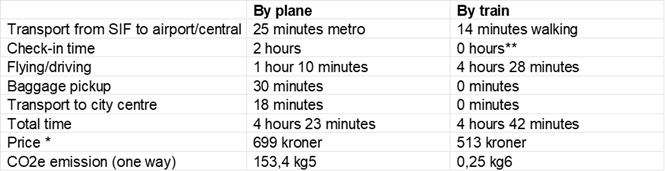

*Price for a plane leaving 08:40 in the morning from Copenhagen to Stockholm with a checked in bag, Tuesday the 14th October, and a train leaving the same day at 07:59. The roundtrip for plane was 1031kr when returning a week later at the same time.
When looking at ticket prices for tomorrow (11th of July as of writing), the train remains cheaper.
**It is of course advisable to be at the train station some time before departure, however we have decided to not include this in the calculation, as this could also be added to the metro train departure and train transport from Stockholm Arlanda airport to Stockholm city centre.
As is evident from the table above, the difference in time is negligible, while emissions are more than 600 times higher when flying. Additionally, the time spent travelling by train is collected in one pool of time, giving you a better opportunity to work while traveling, and heightening your comfort. We could recently read about colleagues from Odense who took the train from Odense to Stockholm3 .
SDU’s Travel policy
SDU encourages all employees to consider whether a travel is necessary, and to consider if an online meeting could be a viable alternative. When a travel is necessary, employees are encouraged to choose the mode of transportation with the lowest possible CO2e emissions. In particular, SDU discourages flying for journeys less than 500km, or within Denmark. If flying is unavoidable, employees should choose the most direct route, as take-offs and landings during layovers come with large emissions7.
Foundations sustainability awareness and travel considerations
In line with SDU’s strategic focus, several foundations have also increased their awareness of sustainability. This is clearly reflected in, for example, the Danish Independent Research Fund’s (DFF) 2025/26 call:
“DFF expects that applications to the fund meet the administrating institution’s possible guidelines for reduction of the climate footprint. This also includes the choice of modes of transportation in connection with any travel activities, which will take place as part of the research projects funded by DFF.
Similarly, the Velux Foundation encourages applicants to consider how sustainability is embedded in the project’s design and implementation:
“How will the project incorporate principles of sustainability or specific sustainable actions? For example, in frameworks, processes, recruitment, consumption, or transportation, etc.”
While sustainable travel options such as train journeys are not always the most cost-effective, these statements indicate a willingness from the foundations to support higher costs for low-emission alternatives when justified. We will address this in upcoming application rounds, where relevant.
We hope that this text has served as an inspiration to you and encourages you to consider your choices for your next travel and coming projects.
Green greetings
SIF Klima
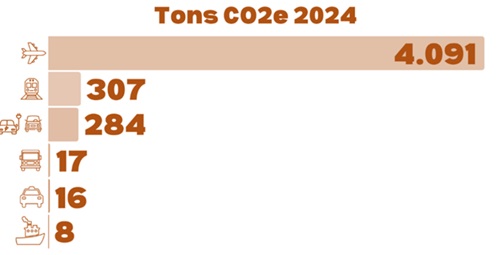
Figure 1. CO2e emissions from modes of transportation. All of SDU2.
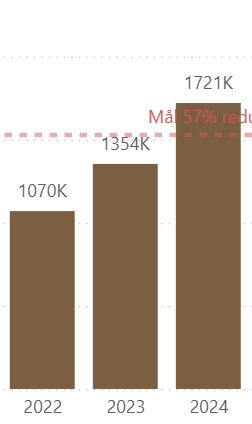
Figure 2. CO2e emissions from flying, all of SDU.4
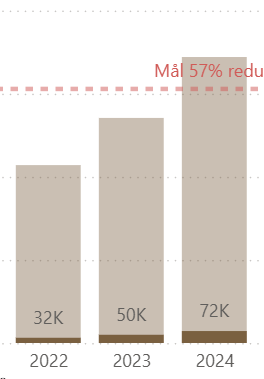
Figure 3 CO2e emissions from flying. Dark brown area is SIF emissions4.
References
- Ikke overraskende – men skuffende! sdunet. Accessed July 10, 2025. https://sdunet.dk/da/nyheder/rektoratets-nyhedsbrev/klumme/apr-25/ikke-overraskende
- Klimaregnskaber. sdu. Accessed July 10, 2025. https://www.sdu.dk/da/om-sdu/strategi-politikker/klimaregnskab/klimaregnskaber
- Tog til Stockholm – et skridt mod mere bæredygtige tjenesterejser. sdunet. Accessed July 10, 2025. https://sdunet.dk/nyheder/nyheder_fra_sdu/tog-til-stockholm-et-skridt-mod-mere-baeredygtige-tjenesterejser
- Fokusrapport_Flyrejser - Power BI. Accessed July 10, 2025. https://app.powerbi.com/groups/me/reports/e67e5ea7-8cf2-4469-9238-7654f88a47d4/ReportSection?ctid=9a97c27d-b83e-4694-b353-54bdbf18ab5b&experience=power-bi
- Flight carbon footprint between Stockholm (ARN), and Copenhagen (CPH). Accessed July 10, 2025. https://curb6.com/footprint/flights/stockholm-arn/copenhagen-cph
- Snälltåget Copenhagen–Malmö–Stockholm | Cosy Dining, Discounts, and Private Compartments | Snälltåget. Accessed July 10, 2025. https://www.snalltaget.se/en/copenhagen-malmo-stockholm
- Cirkulærer om tjenesterejser. sdunet. Accessed July 10, 2025. https://sdunet.dk/da/servicesider/oekonomi/rejser/cirkulaerer-tjenesterejser