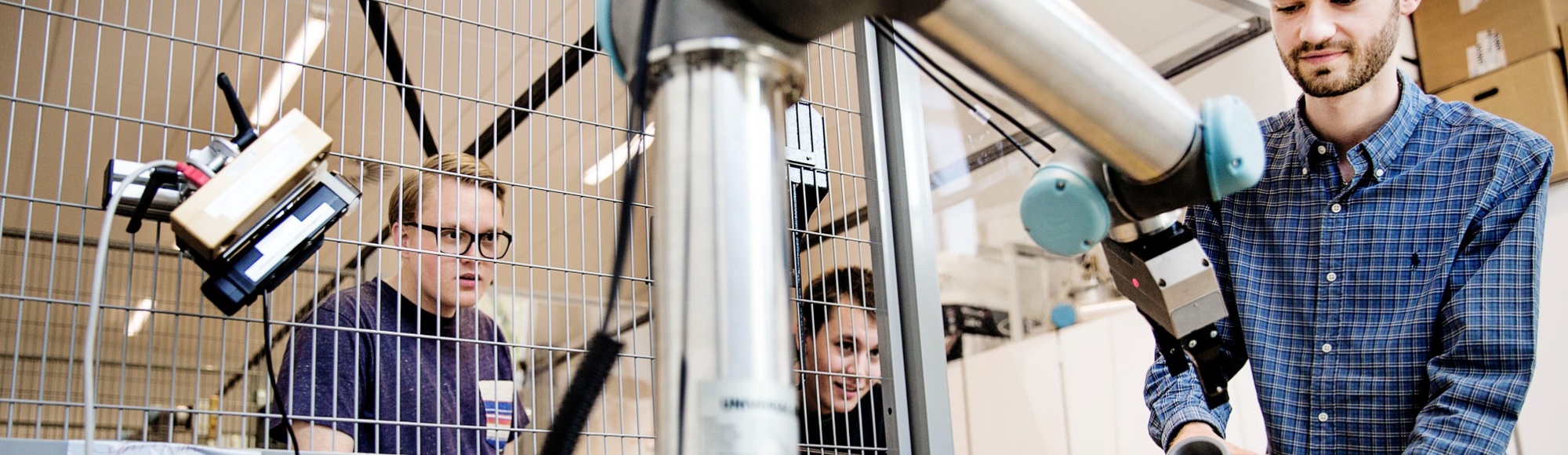
Industrial Master’s in Mechatronics Engineering starts in 2026
As part of the Master’s Degree Reform, SDU launches a work-based master’s pathway that builds on existing industry collaboration and targets thermal-fluid systems and control.
Why launch already in 2026?
For Andrei-Alexandru Popa, Mechatronics Head of Program, the Industrial Master's Degree in Mechatronics Engineering is a natural extension of what the programme already does. The regular master is closely connected to industry through company projects embedded in courses and through student work anchored in real industrial challenges. Many students are also already employed during their studies, for example as research assistants or student helpers on projects with industrial partners.
- For us this is just a different way of framing what we are doing already because of our historically tight connections to industry - the very backbone of our educational approach, says Andrei-Alexandru Popa.
The industrial master format does not replace the existing master's pathway. It gives the collaboration with companies a clearer structure and more room for synergy. That is why, he argues, it makes sense to launch the programme already in 2026.
At SDU, the industrial master runs over three years. The first year is full time studies. The final two years combine part time studies with paid employment of at least 25 hours per week.
From university projects to inside industry
Popa describes the key shift as a move from industry related university projects to work carried out inside the company. The student is not only solving industry inspired assignments at the university. The student is employed in the company and works on industrial problems, supported by the university's academic framework, methods, and facilities.
- The point is that the students are not just working on projects at university that are industry related, they are working in industry with the help of the university on the industrial problems, he says.
A distinctive profile around the mechatronics of thermal-fluid science
Industry relevance is essential, Popa says, and the programme also needs a distinctive profile. Mechatronics is defined by combining disciplines, and this industrial master builds on that strength with a focus on thermal fluid and hydraulic systems. He links that focus to needs in regional industry, including companies working with thermal systems and hydraulics.
His point is that graduates who specialise in thermal fluids or hydraulics often lack parts of control engineering, while students with a strong control profile can lack deeper understanding of thermal fluid systems. The industrial master is designed to bridge that gap. Control is taught in the context of thermal fluid systems, and thermal fluid topics are taught with control as an integrated perspective.
Popa also highlights new facilities, including a CO2 heating and cooling lab, where students can work with regulation and control on real hardware, not only simulations. Hardware-in-the-loop is no longer a mere buzzword in the field, and Mechatronic engineers thrive on this integration which is now made possible by our state-of-the-art facilities, he emphasises.
What companies are offered
To companies, Popa presents mechatronics as a common engineering language that connects mechanics, electronics, and software. The pragmatic advantage of the industrial master is that the student becomes a real resource in the organisation. Working around 25 hours per week makes it possible to take on more substantial tasks than a small student position.
At the same time, the collaboration changes character. The company provides the context and the problem. SDU supports the work with academic input and access to facilities that companies may not have in house.
- This is moving the control points to industry away from saying this is a university project, to this is you giving a resource within your own organisation that we supply support for, he says.
What companies should do to get full value
In Popa's view, good matching is crucial because hiring a student for at least 25 hours per week is a significant commitment. He suggests that companies engage early, already after the first semester, to clarify where the student would fit, which department and tasks make sense, and to meet students in real dialogues. The goal is to reduce mismatch risk for both sides.
The main risk and what success look like
The main risk is committing to someone you do not yet know well enough. One way to reduce that risk is to build the relationship earlier, for example through smaller student positions during the first year, bachelor projects, or internships that can lead into the industrial master pathway.
For Popa, success is when companies can point to work and results that would not have been possible in the same way without this structure, and when graduates move into full time engineering roles after finishing.
With the industrial master, SDU uses the new framework from the master's reform to strengthen a collaboration that already exists. From 2026, the programme will test how a work-based master can create added value for students, companies, and the region through a clearer structure and a distinctive technical profile.
From 2028, the master's programme reform will change the master's landscape. At SDU, this means more ways to complete a master's degree programme without SDU dropping the requirement for high, research-based quality.
SDU is developing new master's programme formats, including business master's programmes, where study and relevant employment are more closely linked. The Master of Science in Mechatronics will begin as early as 2026 and builds on the programme's close collaboration with industry.
The programme is organised as a three-year course, where students first attend classes full-time and then combine part-time study with paid employment in a company. The programme strengthens the link between the university's academic framework and companies' specific technical problems in mechatronic systems, thermal fluid systems and control.