The purpose of this procedure is to ensure systematic prevention of all relevant environmental, safety, and occupational health risks when working with chemical and biological agents, including compliance with all relevant legislation at every stage of the work, such as procurement, transportation, manufacturing, use, handling, development, recycling, and disposal.
The procedure also aims to ensure a certain level of uniformity in how prevention is managed at SDU and to promote a greater degree of transferability (knowledge, methods, tools, assessments, terminology, etc.) between units. The procedure applies to both scientific and technical administrative tasks, except for uses that can be equated with private use.*
* The requirement for chemical risk assessment, etc., is exempted when the use of agents can be equated with private use.
This requires that the risk of exposure is low, the scope/duration is very limited, and the method of use resembles private use.
This may, for example, be the case with:
Use of dishwasher tablets in a standard household dishwasher that runs once a day.
Occasional and brief use of Whiteboard Cleaner.
The Director is responsible for ensuring that this procedure is agreed upon in SDU's Main Occupational Health and Safety Committee.
The Head of HR Occupational Health and Development is responsible for ensuring that the procedure is accessible and communicated to all relevant stakeholders.
The Heads of Department are responsible for ensuring that risk assessments are conducted for all work involving chemical and biological agents, and that the necessary training and instructions are developed and implemented. The responsibility for carrying out practical tasks can typically be delegated to research/unit leaders. The practical tasks must be performed by individuals with the necessary skills and experience; if required, these must be sourced externally.
The Occupational Health and Safety Groups play a particular role in communication and advising on this procedure, as well as in monitoring and controlling whether the safety measures are effective and adhered to, for example, by conducting safety inspections.
The Institutes' specialists/experts contribute with professional input to the shared SDU guidelines. HR Occupational Health and Development contributes with editorial adjustments and communication of the shared SDU guidelines.
The Main Occupational Health and Safety Committee assesses the need for adjustments to this procedure based on the evaluation of its effectiveness, which is received in connection with the annual discussions at the wet faculties.
Suggestions for improvements to the procedure can be sent to SDU HR, Occupational Health and Development: arbejdsmiljoe@sdu.dk, who will assess and, as far as possible, incorporate the suggestions.
Updated: 7/4-2026
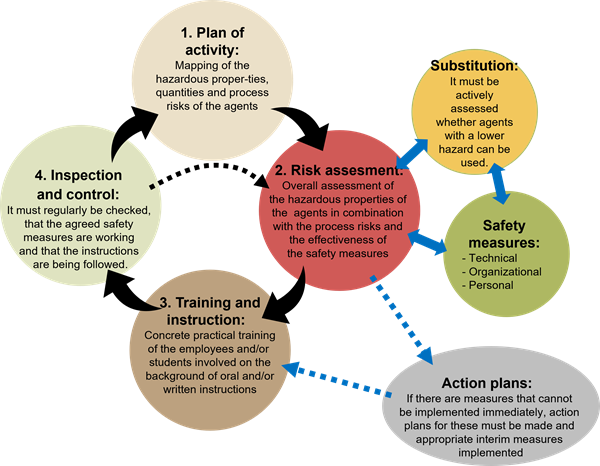
To ensure a high level of prevention, a risk assessment must be conducted as part of the planning process and before initiating any work involving the use of chemical and biological agents. The risk assessment must be documented.
Prior to the risk assessment, it is essential to have knowledge of the hazardous properties of the agents and the process-related risks to ensure that these can be addressed by the safety measures.
The principles of risk assessment are illustrated and described in the process diagram below:
This procedure has been AI translated from Danish and may not be completely linguistically correct. However, we do not believe that the errors are misleading. Suggestions for linguistic improvements can be sent to sbj@sdu.dk.
Prior to the risk assessment, it is essential to have knowledge of the hazardous properties of the agents and the process-related risks to ensure that these can be mitigated by the safety measures.
Information about the hazardous properties of the agents can usually be found via Kemibrug, and the process-related risks can/will to some extent be outlined in the user manuals and safety warnings for the equipment intended for use.
Prevention must always be an integral part of work planning. This also involves adhering to the STOP principle, ensuring that preventive measures are evaluated and implemented in the following order:
Substitution*
Technical measures
Organizational measures
Personal protective equipment
Here you can find examples of tools/templates for chemical/biological risk assessment:
* If it is not technically feasible to substitute the use of particularly hazardous agents (e.g., CMR substances), or if it results in disproportionately high additional costs, this must be documented in writing as part of the risk assessment, including an explanation of why substitution was not carried out and what alternatives were explored.
Based on the risk assessment, it is decided how users are made aware of the risks and trained and instructed regarding the safety requirements for performing the task.
The written risk assessment must be available to users and included in the training/instruction.
The overall training and instruction will often be a combination of peer training supplemented with oral and written instructions. Written instructions should be kept short and precise wherever possible. However, it is the responsibility of the client.
For activities with low complexity and risk, a general laboratory/workshop instruction may be sufficient and can also include the documentation for the risk assessment.
Depending on the specific risks, all units must agree on an appropriate concept for the supervision and control of laboratory/workshop facilities and activities.
The daily/regular monitoring and supervision of activities and conditions in laboratories/workshops will typically be the responsibility of the laboratory/local managers.
The periodic inspections can, to a significant extent, be part of the semi-annual safety rounds (Link to SDU procedure regarding safety rounds), which provide an opportunity to, among other things, check:
that the required risk assessments and instructions have been carried out,
that unnecessary and/or unsuitable (e.g., too old) chemical and biological agents are not being used or stored,
that the agents are correctly stored and labeled,
that the guidelines for disposal, etc., are being followed.
Before activities involving new chemical and/or biological risks are initiated in a unit, a special "start-up safety round" should be conducted.
Guidelines on Specific Conditions, Risks, and/or Requirements
In collaboration with the specialists/experts from the institutes, SDU HR Work Environment and Development prepares and maintains a range of guidelines addressing specific conditions, risks, and/or requirements related to working with chemical and biological agents.
To ensure a relatively uniform level of safety and approach, the guidelines must be particularly observed in connection with planning, risk assessment, and the preparation of instructions. The guidelines are available on SDUnet.dk.
Tools
A shared library of tools, templates, and examples is being established, which can be used for the tasks described in this procedure. These may include:
Tools for risk assessments with examples
Templates and examples of written instructions
Examples of laboratory instructions for different types of laboratories
Link to guidelines and tools is under development.
In general, procurement must be carried out via SDU's central procurement or the unit's procurement function.
Before procuring agents that have not previously been used in the unit, the person placing the order with the procurement function should ensure that a risk assessment is available. It must always be evaluated whether agents with a lower risk level can be used (the Substitution Principle).
It is also the responsibility of the purchaser to identify and inform the procurement function of any special risks and/or requirements when procuring the agents. Efforts should be made to ensure that the procurement functions also have or have access to expertise in identifying special risks and requirements.
Efforts should be made to ensure that the procurement functions have or have access to expertise in identifying special risks and/or requirements when procuring or using the agents.
As a state educational institution, SDU is exempt from the general requirements for permits for the procurement and use of particularly hazardous chemical agents.
However, there are special requirements for notification, registration, documentation, etc., regarding, among other things:
Peroxide-forming substances
Euphoric substances
Animal by-products
GMO 1 and 2
“CBB substances” (Biological agents that can be used as weapons)
Undenatured alcohol (ethanol)
This procedure also applies if agents are procured outside the procurement function or received as a gift.
Chemical Usage Instructions (KBAs):
KBAs must be created in Kemibrug for all chemical agents used. (If KBAs are missing, they must be requested from Kemibrug via the unit's Kemibrug editor/administrator)
Data regarding biological agents can advantageously be created as "local registrations" in Kemibrug. This allows for attaching documentation that can/must be used during risk assessment and for creating labels.
The relevant KBAs and/or data regarding biological agents are used to map the hazardous properties involved in the current activity.
Labels:
All chemical and biological agents must be clearly and correctly labeled. This also applies when transferring to non-original packaging and/or when preparing mixtures and dilutions, as well as when using small containers such as syringes, petri dishes, etc. Used packaging must not be reused for other purposes. For agents, labels for both pure substances and mixtures can be printed from Kemibrug.
Inventory Lists:
For chemical agents, inventory lists can be created and updated via Kemibrug. It must be regularly checked that the inventory lists reasonably match the actual stock/inventories.
Storage:
Chemical and biological agents must be stored in dedicated cabinets or depots designed for the purpose and located so that any spills can be controlled. Agents that may emit odors and/or vapors must be stored in areas with adequate ventilation. At workplaces, agents should generally only be stored in quantities necessary for daily work. Fume cupboards must not be used for storage.
Storage under lock:
Agents labeled as toxic must be stored in separate ventilated cabinets and under lock. When storing more than 125 ml of toxic agents collectively, one or more safety officers must be appointed.
Agents must not be stored beyond the expiration date indicated on the packaging. Agents that are no longer in use should generally be disposed of unless there is a reasonable expectation that they will be needed again within a short period.
The transport of agents must comply with the rules for the Transport of Dangerous Goods (ADR 1.3.). (Guidelines under preparation). Upon delivery of the goods, they must be placed securely and correctly. For example, there may be requirements for storage under lock or at cool or freezing temperatures.
Unauthorized persons must not have access to the agents during either transport or storage. This requires monitoring of all transport and effective access control to laboratories, storage rooms, etc.
There are requirements for signage in a number of situations involving the storage and use of hazardous agents. Link to SDU guidelines on signage(needs updating)
Waste containing chemical and biological agents must be disposed of in accordance with SDU's guidelines for the disposal of hazardous waste. (Guidelines under development)
Waste management and disposal must be clarified in connection with risk assessments. Disposal of liquid or solid chemical and biological agents (including particles) via drains/sewers and/or regular waste collection will generally not be permitted.