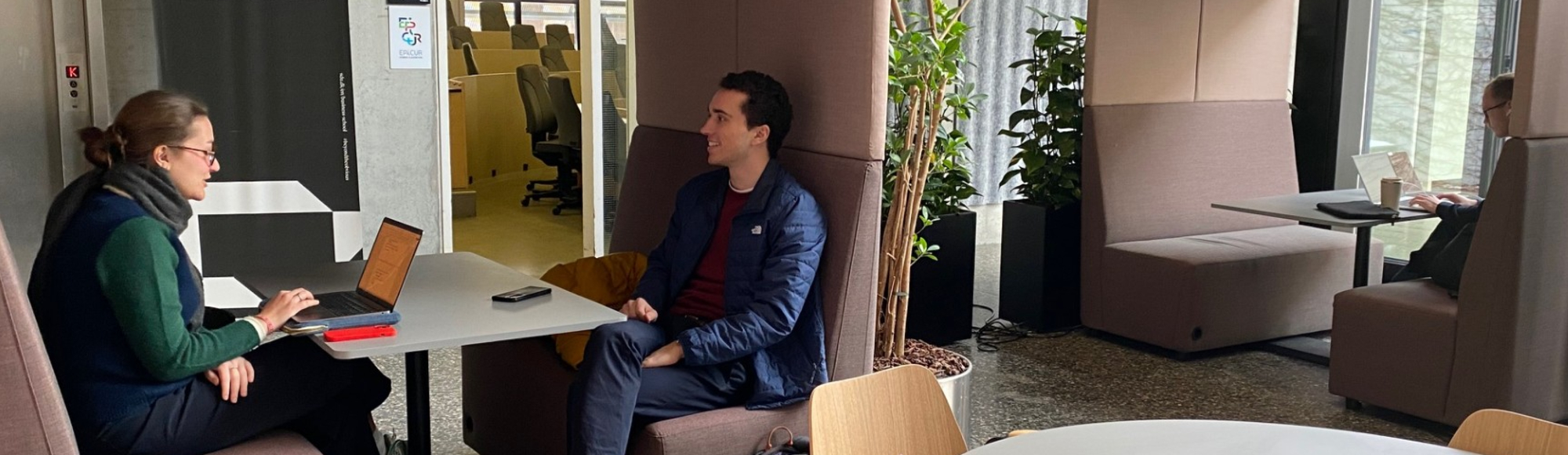
New study zones to ensure student well-being and strengthen community at SDU BSS
Our students in Odense are now seeing a significant improvement in their physical study environment. New, vibrant spaces are being created to strengthen the sense of community across programmes and year groups.
Together with the Faculty of Business and Social Sciences, SDU has taken a visible step in the work to strengthen the study environment on campus in Odense. The physical environment for SDU BSS students in Odense has lagged behind other campus cities. Therefore, creating more vibrant environments that strengthen the community across programmes of study and years has been high on the agenda.
We asked about the thoughts behind the new layout, which everyone will clearly notice in the corridors. Senior consultant for student life and well-being Kirstine Ravn Kjems found time to put into words the work of the project group - work that has been underway long before the furniture and walls were recently installed.
- We want to create spaces where student life can unfold naturally, both academically and socially. Therefore, the study zones should be places where you feel welcome and where students feel part of a community," says Kirstine Ravn Kjems, who has been involved in the project group behind the development of the new areas. She continues:
- The design in Odense will function as part of the faculty's #samhør initiative, where both well-being and relationships across programmes of study and years are in focus in all campus cities. It's about creating a sense of security in the space, so people know where they can find peace and where they can find community. The zones are intended as places where cohesion can grow and be felt in everyday life.
By investing in good study zones, we as a place of study send a signal that we take students' well-being and academic communities seriously. For Kirstine Ravn Kjems and the rest of the project group, it was therefore important that the students were active and played a central role in the planning and design phases of the actual development work. Student representatives have therefore been involved from the start, so that the interior design reflects the everyday life they are a part of.
Among other things, they have emphasised the need for flexible workstations, plenty of space for group work and the opportunity to "be together separately". According to Kirstine Ravn Kjems, it is no coincidence that these needs are emphasised in the design. The study zones should function as informal meeting places where professional identity is developed and where both social and professional communities arise spontaneously. The new study zones differ significantly from the previous static communal areas.
Kirstine Ravn Kjems elaborates:
- You don't meet on campus just to 'hang out', but to be students together. The ambition is for the areas to provide space for the entire student life, inviting both immersion and concentration as well as group work and respite. They are designed to be active meeting places that are anything but a place where you pass by, but a place where you want to spend time, says Kirstine Ravn Kjems. She concludes:
- The idea is that when students feel that there is always a place to belong, it becomes easier to create relationships and engage in academic communities, which are central to their well-being. If students experience the new study zones as a safe and inspiring base for their duration of study, then we have succeeded in creating the connection we aim for.